
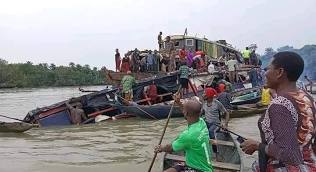

A search-and-rescue team is urgently scouring the waters of Jigawa state for survivors after a wooden passenger canoe carrying roughly 40 people, mostly female farmers and laborers, capsized on Sunday. While 23 individuals have been pulled from the river alive, nine bodies have been recovered, adding to a grim and relentlessly familiar statistic.
So far this year, more than 55 people have died in Nigerian boat accidents, with dozens still missing.
For millions of Nigerians in rural communities, waterways are not a luxury; they are vital arteries for commerce and connection. Yet, relying on these rivers frequently demands a lethal gamble.
The Root Causes: “Systemic Negligence”
The reasons behind these recurring tragedies are painfully predictable. According to maritime safety experts and local officials, the ongoing crisis is fueled by a combination of failing infrastructure and ignored regulations.
- Overcrowding: Vessels frequently carry passenger loads vastly exceeding their capacity.
- Aging Wooden Vessels: A reliance on old, rickety wooden canoes that lack major repairs or modern structural integrity.
- Zero Safety Equipment: A chronic, severe shortage of life jackets.
- Submerged Hazards: Years of upstream logging have left Nigerian waterways littered with hidden tree stumps. During high tides, these invisible hazards tear through the hulls of weak wooden boats.
- Unlicensed Operators: A significant majority of local boat operators lack formal training on water behavior, tides, and currents.
“These are not acts of fate,” noted one local observer. “They are the predictable consequences of systemic negligence.”
A Crisis of Enforcement
The regulatory framework to prevent these disasters exists, but implementation is virtually nonexistent. The Water Transport Code, passed in January 2023, mandates life jackets for all passengers on large bodies of water and restricts commercial boats to registered jetties.
However, Timothy Iwuagwu, president of the Institute of Safety Professionals of Nigeria, points out the fatal flaw: “These laws are hardly implemented. Any regulation is as good as its implementation.”
The National Inland Waterways Authority (Niwa) announced late last year that life jackets were obligatory nationwide. Yet, frontline enforcement remains paralyzed by a lack of resources.
“Our boats usually carry well over 100 passengers. But most of the time, we can only provide life jackets for 10 people, or even fewer, because we simply don’t have enough.”
— Mallam Sala Altine, Sarkin Ruwan Shiroro (Lake Safety Chief, Niger state)
Even when safety gear is available, resistance persists. Ibrahim Husseini of the National Emergency Management Agency in Niger state notes that many riverine residents, accustomed to the water, find life jackets uncomfortable and refuse to wear them. This cultural resistance disproportionately endangers women, who frequently travel the waterways for commerce and family events but are statistically less likely to know how to swim.
The Human Toll
The statistics mask a devastating human reality. Between January 2023 and October 2025, Niger state alone accounted for a significant portion of the nearly 860 water transport deaths recorded across Nigeria.
For Isiyaka Bello, the grief is an everyday burden. He lost his wife last year alongside eight others as she returned from a Kebbi state market. “She left behind four children, and I am still struggling to adjust to raising them on my own,” Bello shared. “Whenever I pass by a large body of water, all I think about is her.”
A Blueprint for Survival: The Lagos Model
While rural waterways remain hazardous, Nigeria’s largest city proves that maritime safety is achievable. Lagos, a coastal metropolis heavily reliant on water transport to bypass legendary traffic gridlock, once suffered frequent tragedies—recording 92 deaths between January 2018 and October 2023.
Today, those numbers have plummeted. The Lagos State Water Authority reported only one fatality in 2024, six in 2025, and zero deaths recorded so far this year.
Lagos Ferry Services achieved this dramatic turnaround through four strict measures:
- Providing modern, standardized boats and life jackets.
- Regularly dredging water channels to remove hazards.
- Deploying water guards at every terminal and jetty.
- Mandating strict training and licensing for all operators.
Nigeria’s Minister of Marine and Blue Economy, Adegboyega Oyetola, has appealed to state governments to abandon wooden canoes entirely, pushing for investments in safer fiberglass and aluminum vessels.
Until the Lagos model is funded and replicated nationwide, rural Nigerians will continue boarding aging wooden canoes, hoping their routine journey to the market doesn’t become another national headline.


 By
By