
NEW BRITAIN — In 1943, a 27-year-old American pilot fell out of the sky and plunged into one of the most unforgiving jungles on earth. What happened next is a staggering story of human compassion, extreme danger, and a debt of gratitude that took an entire lifetime to repay.
For 31 agonizing days, Fred Hargesheimer wandered alone through the dense, sweltering rainforest of New Britain. His reconnaissance plane had been blasted from the sky over Japanese-controlled territory. Starving, delirious, and barely clinging to life, the young pilot survived on nothing but roots and stream water, moving like a ghost through the night to evade deadly Japanese patrols.
By the 32nd day, when voices finally broke through the tree line, Fred was certain his time was up. He believed the Japanese had finally found him.
He was wrong.
A Defiant Act of Mercy
Instead of enemy soldiers, Fred was discovered by a group of Nakanai tribesmen. Seeing the emaciated American, they didn’t hesitate. They carried him back to their coastal village and made a life-threatening decision: they would hide him.
The stakes could not have been higher. The Japanese military was actively offering rewards for captured Allied airmen and executing anyone caught aiding them. Had the village been discovered, it would have faced a certain massacre.
Fred was so deathly ill he could no longer swallow solid food. It was then that a nursing mother named Ida stepped into the hut. In an astonishing act of sacrifice, Ida returned with a cup filled with her own breast milk. For ten days, she fed the American pilot from her own body to keep him alive, all while continuing to nurse her own infant. Fred never forgot her name.
The Children and “Mastah Preddi”
Protecting Fred became a highly coordinated village operation. The Nakanai people developed an intricate warning system to keep the young pilot hidden from relentless enemy patrols:
- The Conch Shell Alarm: Whenever Japanese troops neared the village, a designated lookout would blow softly into a hidden conch shell. That haunting sound gave Fred mere seconds to vanish into the brush.
- The Footprint Sweepers: If Fred had to sprint across the sand in his heavy boots, village children trailed right behind him, furiously brushing away his tracks with tiny palm-frond brooms before the soldiers arrived.
Unable to pronounce “Freddie,” the devoted village children affectionately dubbed him “Mastah Preddi.”
The Escape and the Haunting Question
For seven months, Fred lived among the Nakanai. Finally, in February 1944, Australian commandos reached the village and radioed for an American submarine extraction. On a pitch-black, moonless night, Fred paddled a canoe out to the waiting submarine. The villagers watched from the shore, some mothers even offering their children for Fred to take to America for a better life.
Fred survived the war, returned to Minnesota, married his wife Dorothy, and built a successful, normal life. Yet, a singular, burning thought haunted the salesman every day:
“How could I ever repay them?”
A Lifelong Vow
In 1960, Fred found his answer. He journeyed back to New Britain alone. As his boat scraped against the moonlit beach, he found the villagers waiting for him. In a tear-jerking welcome, they sang the only English song they knew: “God Save the Queen.”
Fred collapsed into the sand and wept. He reunited with Ida. He even met the grown son she had been nursing alongside him during the war. But Fred decided that simply saying “thank you” wasn’t enough. Learning the village desperately needed a school, the middle-aged salesman returned to Minnesota and began going door-to-door, raising funds through church groups and small donations.
By 1963, Fred returned to New Britain and helped erect the village’s first permanent school.
Over the next several decades, his repayment took monumental forms:
- He and Dorothy uprooted their lives, leaving America entirely for four years to teach children at the foot of a volcano, 12,000 miles from home.
- He funded and helped construct multiple schools and libraries.
- He built a badly needed medical clinic for the region.
In 2000, in recognition of his unwavering devotion, the Nakanai people made him an official tribal chief, bestowing upon him the title “Suara Auru”—Chief Warrior.
One Final Journey
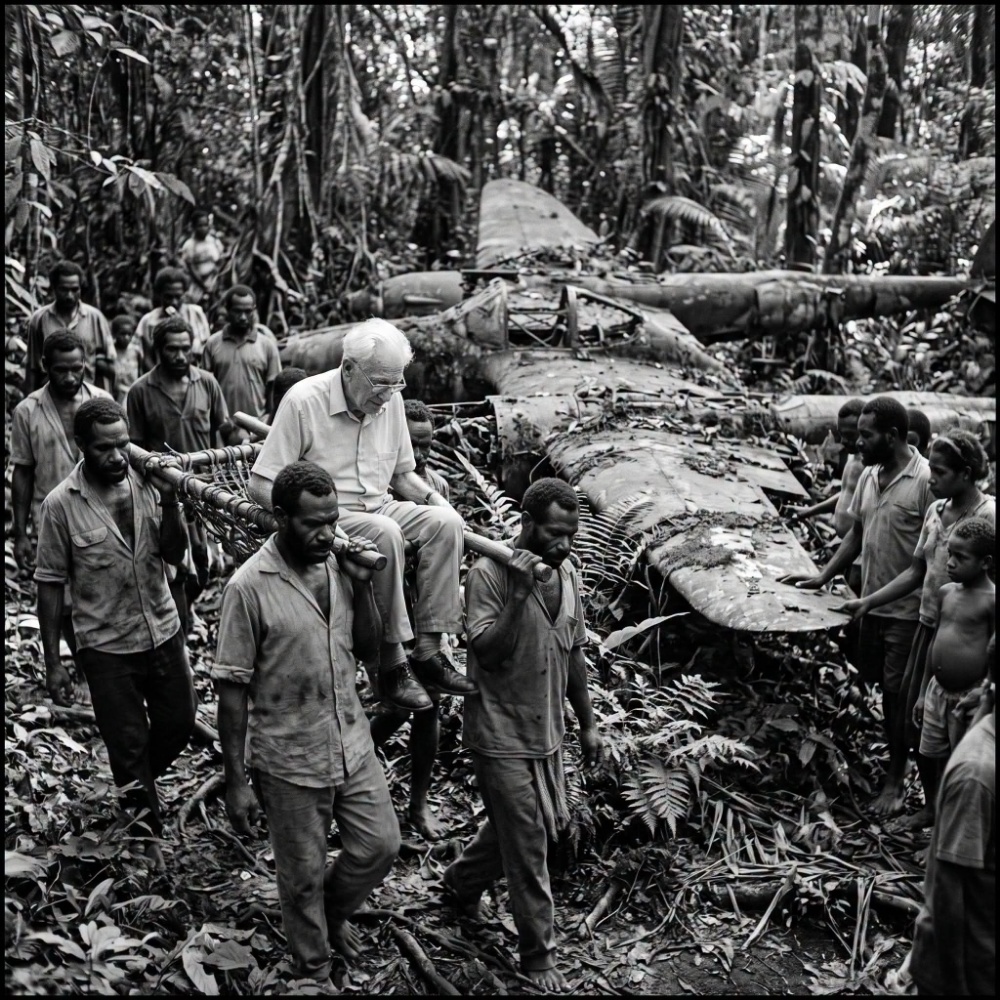
In 2006, at 90 years old, Fred made one last, grueling trek into the jungle. The wreckage of his 1943 plane had finally been located. As captured in the file 1681891.jpg, a dozen villagers hoisted the elderly pilot onto their shoulders, carrying him through the dense rainforest so he could see the rusted, broken wings one last time. The very metal that had dropped a starving American into their lives still rested peacefully beneath the canopy.
Fred Hargesheimer passed away in 2010 at the age of 94.
Today, the schools and the clinic he built are still operating, standing as lasting monuments to a bond forged in the darkest days of war. Whenever anyone asked Fred why he dedicated nearly 70 years of his life to a village he easily could have left in the past, his answer never wavered:
“These people were responsible for saving my life. How could I ever repay it?”
He spent the rest of his life trying.
For more incredible historical features and breaking stories, stay tuned to ABT NEWS at www.abtnews.net.



 By
By