
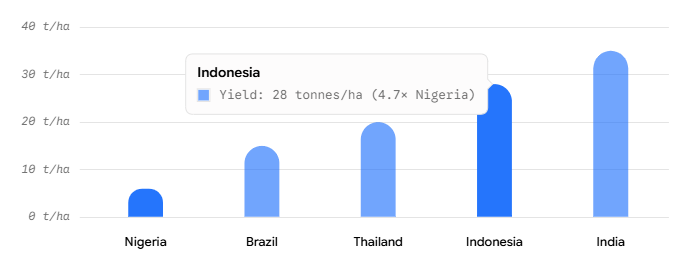
Did you know that one hectare of land in Nigeria produces just 6 tonnes of cassava, while the exact same portion of land yields 15 tonnes in Brazil, 20 tonnes in Thailand, 28 tonnes in Indonesia, and an astounding 35 tonnes in India?
Consider the gravity of those figures: One single hectare in India produces nearly six times more cassava than one hectare in Nigeria.
The immediate question facing policymakers, agribusiness leaders, and development experts across Africa is simple yet urgent: Why are we still struggling to feed ourselves despite boasting millions of hectares of arable land?
The answer is not a lack of land, nor is it a lack of hardworking farmers planting crops every season. The root cause is our failure to build an integrated economic ecosystem around agricultural production.
The Misplaced Priority: Agriculture as “Poverty Alleviation”
If Nigeria were to simply elevate its yield from 6 tonnes to Thailand’s benchmark of 20 tonnes per hectare, national output would instantly quadruple without clearing a single extra acre of land.
Africa’s fundamental agricultural failure stems from a flawed political paradigm: treating agriculture merely as a social welfare program to alleviate rural poverty.
For decades, government interventions across the continent have followed a predictable, ineffective blueprint: hand a poor farmer a hoe, a cutlass, two bags of subsidized fertilizer, and a few hectares of land, then declare it “agricultural development.” This approach keeps the farmer trapped at a subsistence level—producing just enough to keep their family fed, but never enough to build enduring wealth.
Nations like Israel, Brazil, and the United States do not view agriculture as poverty relief; they treat it as a wealth-generating agro-industrial complex.
Building the Economic Ecosystem: Connecting the Dots
To transition from subsistence farming to genuine wealth creation, farmers must be fully integrated into an end-to-end agricultural ecosystem. Giving a farmer inputs without market structure and processing power is a road to nowhere.
An authentic agricultural ecosystem deliberately connects the rural producer to eleven critical pillars:
- Applied Agricultural Research (disease-resistant, high-starch varieties)
- High-Yield Planting Materials
- Mechanization & Modern Agronomy
- Structured Rural Financing & Insurance
- All-Season Irrigation Systems
- Post-Harvest Storage & Cold-Chain Logistics
- Feeder Transportation Networks
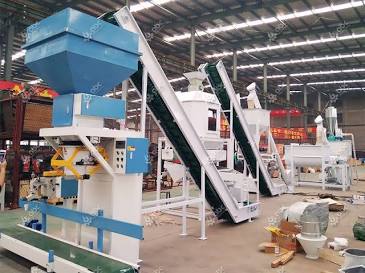
- Industrial Processing Factories
- Commercial Packaging
- Off-Take Domestic Markets
- Global Export Corridors
When these components lock together, agriculture stops being a struggle for basic survival. It becomes industrialization.
Unlocking Regional Industrial Corridors
This ecosystem approach provides a clear industrialization blueprint for Nigeria’s major cassava-producing belts:
- Benue State: Moving beyond the static label of the “Food Basket of the Nation” to become an agro-industrial hub processing high-grade cassava into ethanol and industrial starch.
- Cross River State: Developing cassava processing alongside commercial cocoa and oil palm value chains.
- Ogun & Oyo States: Linking large-scale farm clusters directly to agro-processing plants serving the massive consumer and industrial manufacturing markets of nearby Lagos.
- Kogi & Nasarawa States: Establishing agricultural processing corridors tied to central transportation routes for national distribution.
- Edo, Delta, Rivers & Akwa Ibom: Cultivating commercial agro-industries that generate internal tax revenues, systematically reducing reliance on volatile crude oil allocations.
Crucially, the focus must shift beyond raw produce or basic foodstuffs like garri and fufu. The real wealth lies in downstream value addition: converting cassava into industrial starch, bio-ethanol, high-quality cassava flour (HQCF), glucose syrup, industrial sweeteners, and commercial animal feed.
The Agro-Industrial Formula
Farm ———-} Factory ————–} Market ————–} Export
This four-stage chain is how modern economies generate food sufficiency, industrial jobs, tax revenues, foreign exchange, and lasting wealth.
The Way Forward: Measuring What Matters
Nigeria and the broader African continent must stop measuring agricultural success by political input metrics—how many tractors were handed out at photo ops, how many bags of fertilizer were distributed, or how many millions of hectares were cleared.
Those are merely inputs. The true metrics of economic success are:
- Productivity: How many tonnes did each hectare produce?
- Value Addition: How much value and industrial output did we extract from that harvest?
This mindset shift applies across all agricultural commodities—whether rice, maize, yam, soybean, cocoa, oil palm, or tomatoes.
Africa does not simply need more cultivated land; Africa needs a Productivity and Agro-Industrial Revolution. A nation cannot distribute its way into prosperity. First it must produce, then process, and export its way into wealth.
ABT NEWS Platform is absolutely free for all to enjoy. However please support us by grabbing a copy of the above eBook. A portion of the sales goes towards supporting girls to acquire AI skills. Donations towards that are also possible via PayPal using our email: info@abtnews.net



 By
By