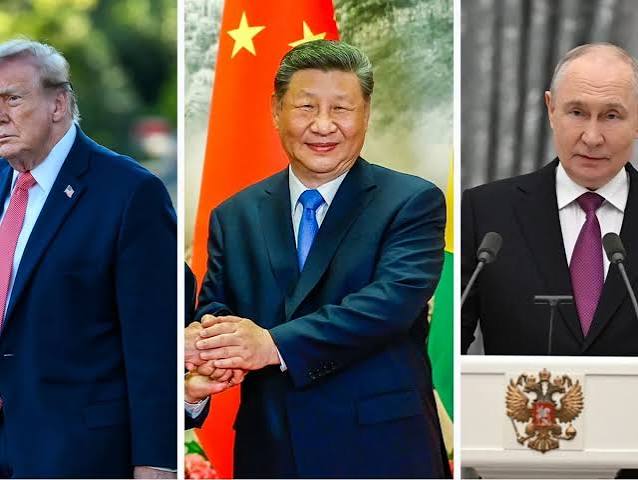

SHENZHEN / LONDON — Global diplomacy is bracing for a historic shift as the White House officially confirms that U.S. President Donald Trump, Russian President Vladimir Putin, and Chinese President Xi Jinping will hold an unprecedented trilateral summit next week.
Taking place on November 19 on the sidelines of the Asia-Pacific Economic Cooperation (APEC) forum in Shenzhen, China, the gathering marks the first three-way meeting between the leaders of the world’s top military and economic powers.
While the optics of Washington, Moscow, and Beijing sitting at the same table have triggered immediate alarm bells across London, Brussels, and Kyiv over fears of a “Yalta-style” carve-up of global influence, recent diplomatic maneuvers reveal a complex reality behind closed doors.
ABT NEWS presents a complete breakdown of what is cooking in Shenzhen, why the summit is happening now, and what it means for the future of Ukraine, the United Kingdom, and European security.
Why Are Trump, Putin, and Xi Meeting Now?
Originally floated by the Kremlin in mid-October, the trilateral summit brings together three leaders with overlapping, yet fiercely competing and strategic agendas. According to senior U.S. officials and diplomatic analysts, the meeting is driven by three primary catalysts:
- Nuclear Arms Control After New START: Following the expiration of the New START treaty in February 2026, President Trump rejected a simple extension with Moscow, demanding instead a “new, improved and modernized” trilateral nuclear framework that brings Beijing into the fold. With China rapidly expanding its nuclear arsenal alongside the U.S. and Russia, Washington views Shenzhen as an opening gambit to curb a three-way arms race even though White House officials admit expectations for an immediate breakthrough remain low.
- De-escalating the War in Iran: Despite initial speculation that Ukraine would dominate the talks, senior U.S. officials confirmed on November 13 that the war in Iran and Middle East stability are top priorities on the Shenzhen agenda. Facing mounting military and economic strain from the Middle East conflict, Washington is seeking diplomatic leverage and de-escalation channels through Beijing and Moscow.
- Geopolitical Optics and Leverage: For Vladimir Putin, standing shoulder-to-shoulder with Trump and Xi projects global legitimacy and signals to the West that Russia is far from isolated. Meanwhile, Xi Jinping who has met Putin over 40 times since 2013, is positioned as a central global power broker hosting two rivals on Chinese soil.
Why Was Ukraine Dropped from the Trilateral Agenda?
When reports of the summit first surfaced, fears immediately mounted in Kyiv and European capitals that Washington, Moscow, and Beijing would attempt to broker a ceasefire over Ukraine’s head, echoing the 1945 Yalta Conference, where major powers redrew borders without the consent of smaller nations.
However, in a major late-breaking shift ahead of the summit, the White House confirmed that Russia’s war in Ukraine is not expected to be formally discussed during the Trump-Putin-Xi trilateral, nor does Trump have a separate one-on-one bilateral meeting scheduled with Putin.
Why the pivot?
- Strong Pushback from Kyiv: Ukrainian President Volodymyr Zelensky and Foreign Minister Andrii Sybiha flatly rejected any three-way talks excluding Ukraine. Sybiha warned that a U.S.-Russia-China format without Kyiv would only “encourage Putin to continue this war,” reiterating Ukraine’s red line: “Nothing about Ukraine without Ukraine.”
- Chinese Hesitation: Analysts at the Brookings Institution and European policy centers note that Beijing has been wary of letting Trump and Putin hijack the APEC trade summit to force China into guaranteeing a fragile Ukraine truce.
Is EU and the UK Being Kept at Bay?
While EU and the United Kingdom are excluded from the Shenzhen room, European leaders are actively refusing to be sidelined from the broader peace architecture.
| Geopolitical Arena | Who Is at the Table? | Primary Focus | Status of UK & Europe |
|---|---|---|---|
| APEC Trilateral (Shenzhen) | U.S., Russia, China | Nuclear non-proliferation, Iran war, great-power stability | Excluded from the meeting |
| Ukraine Peace Track (Upcoming) | Ukraine, U.S., Russia, EU + E5 | Ceasefire terms, territorial integrity, security guarantees | Included via the new European negotiating team |
Following U.S.-mediated talks in Abu Dhabi, Washington confirmed that Moscow agreed to European participation in upcoming peace negotiations. In response, European leaders convened in Dublin on November 13 and formally established a unified “European Team” to sit at the negotiating table alongside Kyiv.
As announced by European Council President António Costa, this bloc comprises European Union institutions alongside the “E5” nations of the Coalition of the Willing:
- The United Kingdom
- France
- Germany
- Poland
- Italy
“For the first time, there will be concrete peace talks in the coming weeks at which Europeans will be represented,” German Chancellor Friedrich Merz stated following the Dublin summit, issuing a pointed warning to Washington ahead of Trump’s flight to China: “Please, no surprises.”
What This Means for the UK, Europe, and Kyiv Moving Forward
Even with Ukraine officially off the Shenzhen itinerary, the trilateral summit underscores a stark new reality for London and Brussels:
- The Return of Great-Power Politics: The Trump administration’s willingness to engage directly with Moscow and Beijing on global security signals a departure from traditional transatlantic consensus. Both the UK and EU recognize they can no longer rely solely on Washington to anchor European security.
- The Burden of Enforcement Falls on Europe: Policy experts at the European Policy Centre (EPC) warn that even if a separate ceasefire track gains momentum, Europe and the UK will have to do more, not less. Guaranteeing Ukraine’s long-term defense, funding reconstruction, and deterring future Russian aggression will fall squarely on European shoulders—particularly as U.S. military aid faces domestic constraints.
- Watching for Backchannel Deals: Despite White House assurances that Ukraine won’t be on the agenda, diplomats in London and Kyiv remain on high alert for informal side conversations between Trump and Putin in Shenzhen that could alter U.S. leverage before the E5-EU-Ukraine talks begin.
For now, the UK and Europe have successfully fought their way into the upcoming Ukraine peace framework but as Trump, Putin, and Xi gather in China, the transatlantic alliance faces its biggest test of unity since the war began.
Stay tuned to ABT NEWS (www.abtnews.net) for live updates from the APEC 2026 Summit in Shenzhen and ongoing developments in European security.


 By