
In the modern age of global commerce, fresh seafood, frozen produce, and lifesaving medical supplies travel seamlessly across continents in temperature-controlled transport.
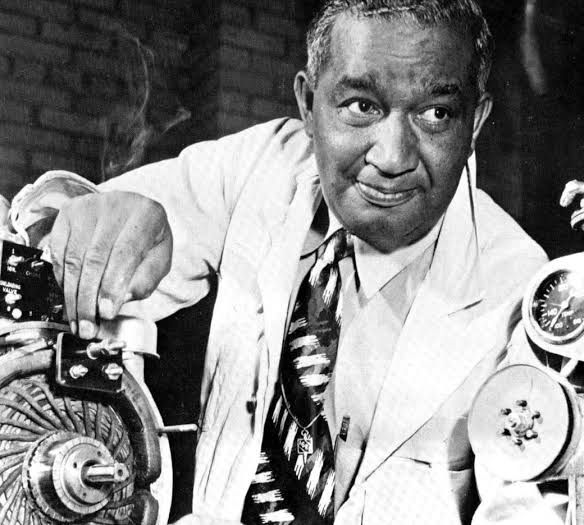
Yet few realize that the foundation of this multi-billion-dollar global infrastructure was built by a self-taught, 6th-grade-educated Black inventor who changed the trajectory of American industry: Frederick McKinley Jones.
From Orphaned Floor Sweeper to Licensed Engineer
Born in 1893, Frederick McKinley Jones faced immense hardship early in life. Orphaned by the age of nine with only a 6th-grade formal education, Jones relied on sheer curiosity, determination, and raw technical aptitude.
At age 13, he took a job sweeping floors at an automobile repair shop in Cincinnati. By 14, he was working as a full mechanic, and by 15, he had risen to shop foreman. His talent caught the attention of business leaders, leading to an opportunity on a 50,000-acre ranch in Hallock, Minnesota, owned by James J. Hill, CEO of the Great Northern Railway. Recognizing Jones’ genius, Hill encouraged his growth, enabling Jones to earn his engineering license despite lacking formal higher education.
When World War I broke out, Jones served in France with the U.S. Army. His exceptional abilities in electrical systems, communications, and engine repair earned him a field promotion to Sergeant—a rare achievement for Black soldiers at the time—as officers routinely transferred him between bases to overhaul critical infrastructure.

A Trail of Inventions: From Snowmobiles to Talkies
After WWI, Jones returned to Minnesota, where he continually solved everyday problems with ingenuity:
- Precursor Snowmobile: To help doctors reach patients during brutal Minnesota winters, he mounted an airplane engine and skis onto a fuselage to create a snow-traversing vehicle.
- Portable X-Ray Machine: He engineered a compact, portable X-ray unit so physicians could examine bedridden patients at home.
- Movie Theater Sound Synchronizer: While working at a local cinema that couldn’t afford expensive sound equipment for newly introduced “talkies,” Jones built an audio-video synchronizer for under $100 that outperformed commercial systems.
- Automatic Ticket Dispenser: Frustrated by slow box-office lines, he invented and patented an automatic ticket dispenser that also returned change—a system widely used through the late 20th century.
The Invention That Transformed Global Food and Healthcare
Jones’ sound synchronizer caught the eye of entrepreneur Joseph A. Numero, who hired Jones at Cinema Supplies. A casual golf course bet in the late 1930s would soon spark one of the greatest innovations in logistics history.
When Numero’s golfer friend complained that spoiled meat made cross-country shipping impossible due to rough roads destroying primitive ice setups, Numero brought the challenge to Jones. Within two weeks, Jones designed a portable, shock-resistant mechanical refrigeration unit for trucks.
Filing over 40 patents for his mobile cooling innovations, Jones co-founded Thermo King with Numero. The invention completely revolutionized the American food system:
- It unlocked the capability to transport perishable foods across long distances without spoiling, scaling the frozen food market into a $100+ billion industry.
- Today, over 35% of vegetables and nearly 80% of meat and seafood rely on mobile refrigeration systems descendant from Jones’ designs.
Saving Lives in World War II and Lasting Legacy
During World War II, Jones’ cooling systems took on a vital military mission. Working alongside Dr. Charles R. Drew—the pioneer of blood plasma preservation—Jones created specialized portable refrigeration units that could be parachuted directly onto battlefields, keeping life-saving blood plasma frozen for wounded soldiers.
Before his passing in 1961, Frederick McKinley Jones filed more than 60 patents across diverse fields. In 1991, he was posthumously awarded the National Medal of Technology by President George H.W. Bush, becoming the first African American recipient of the nation’s highest honor for technological achievement. Inducted into both the Minnesota Inventors Hall of Fame and the National Inventors Hall of Fame, his life serves as a powerful reminder that visionary innovation knows no bounds.



 By