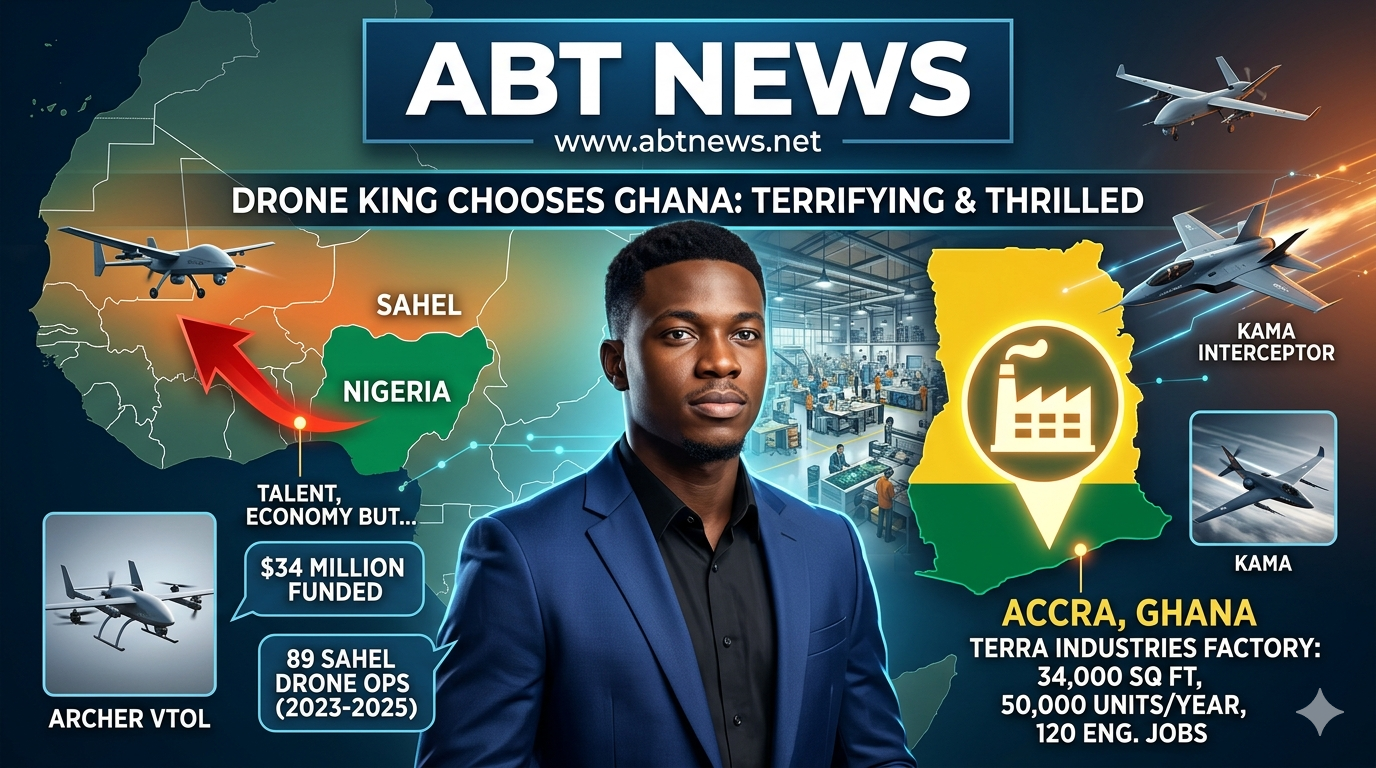

ACCRA, GHANA — In the heart of West Africa, a 34,000-square-foot mega factory is currently under construction. When the dust settles, it will house the continent’s most ambitious defense-tech operation: a factory capable of churning out 50,000 drones a year and providing 120 high-end engineering jobs.
But here is the detail that should make every policymaker in Nigeria wince: the man behind it is a 24-year-old Nigerian, but the factory is being built in Accra.
Nathan Nwachuku, the founder of Terra Industries, is not just building “gadgets.” He is building a sovereign defense shield for a continent under fire. After establishing his first footprint in Abuja, Nwachuku has chosen Ghana for his flagship expansion. The move signals a shift in the tectonic plates of African innovation—and a stinging critique of the Nigerian business climate.
The Architecture of Modern Warfare
The urgency of Terra Industries’ mission cannot be overstated. Between 2023 and 2025, Al-Qaeda and Islamic State affiliates conducted at least 89 recorded drone operations across the Sahel. The threat escalated sharply in January 2026 when suicide drones struck Niamey International Airport, proving that commercial infrastructure is now a primary target.
While African militaries have spent billions on Turkish-made Bayraktars and Akıncıs, Nwachuku identified a glaring “Achilles heel”: a total lack of counter-drone defense!
“You can buy a $500 commercial drone, attach an explosive, and fly it into a hydropower dam,” the industry warning goes. “The entire continent is sitting on critical infrastructure that is basically naked.”
Terra’s response is a three-pronged hardware strategy:
- The Archer VTOL: For long-range surveillance and precision strikes.
- The Iroko UAV: Designed for rapid tactical deployment.
- The Kama: A specialized interceptor drone that travels at 300 kilometers per hour, designed specifically to hunt and neutralize enemy drones.
Follow the Money: The $34 Million Bet
Investors are betting heavily that Nwachuku is the “Anduril of Africa.” In 2026, Terra Industries raised $34 million across two funding rounds. The roster of backers includes Silicon Valley heavyweights like 8VC and Lux Capital, alongside domestic giants like Olugbenga Agboola, the CEO of Flutterwave.
It is the most-funded defense-tech startup in African history. Yet, despite the capital being Nigerian and the talent being Nigerian, the physical assembly lines will roll in Ghana.
| Metric | Terra Industries Factory (Accra) |
| Facility Size | 34,000 Square Feet |
| Annual Capacity | 50,000 Units |
| Engineering Jobs | 120 (Created in Ghana) |
| Assets Protected | $11 Billion (across 8 countries) |
A Tale of Two Environments
The decision to pivot to Accra wasn’t based on a lack of patriotism, but on a surplus of pragmatism. Nwachuku has been candid about the choice, citing Ghana’s “political will to become a serious defense exporter.”
While Nigeria boasts the continent’s largest economy and its most brilliant “hackers and tinkerers,” it continues to struggle with bureaucratic stagnation. The Lekki Special Economic Zone, for instance, took a decade to gain full approval. In contrast, Ghana “made it easy.”
While Nigeria is locked in perpetual debates over fuel subsidies and exchange rate volatility, Ghana has positioned itself as the export hub for the 21st-century arms race—a race defined by software-defined autonomy rather than just heavy tanks.
The High Stakes of Apathy
Terra Industries is already a heavyweight, protecting roughly $11 billion in assets, including lithium mines and hydropower plants, across eight African nations. They have signed a joint venture with DICON (Nigeria’s defense corporation), but the brain trust and the manufacturing muscle are increasingly settling across the border.
The “Drone King” has proven that the technology exists and the capital is ready. The only thing missing is an environment that doesn’t penalize success.
As the Sahel burns and the drones of non-state actors continue to multiply, the clock is ticking. Ghana has proven it has the imagination to lead. The question remains: Will Nigeria wake up before the next Nathan Nwachuku packs his bags for Kigali, Nairobi, or Abidjan?
The factory is in Accra. The ball is in Abuja’s court.
For more updates on African Tech and Defense, visit www.abtnews.net.


 By
By