
Published by ABT NEWS (www.abtnews.net) | Technology & Agriculture Desk
In an era where technology is rapidly reshaping agriculture, an unlikely innovation from halfway across the globe could hold the key to solving one of Africa’s oldest agricultural challenges: human-wildlife conflict. Japan is currently deploying a combination of Artificial Intelligence (AI), automated drones, and terrifying animatronic “Robot Wolves” to protect its communities. For African farmers grappling with crop-raiding elephants and livestock-hunting predators, this technology offers a revolutionary blueprint for maximum advantage.
The Japanese Catalyst: Desperate Measures for Record Threats
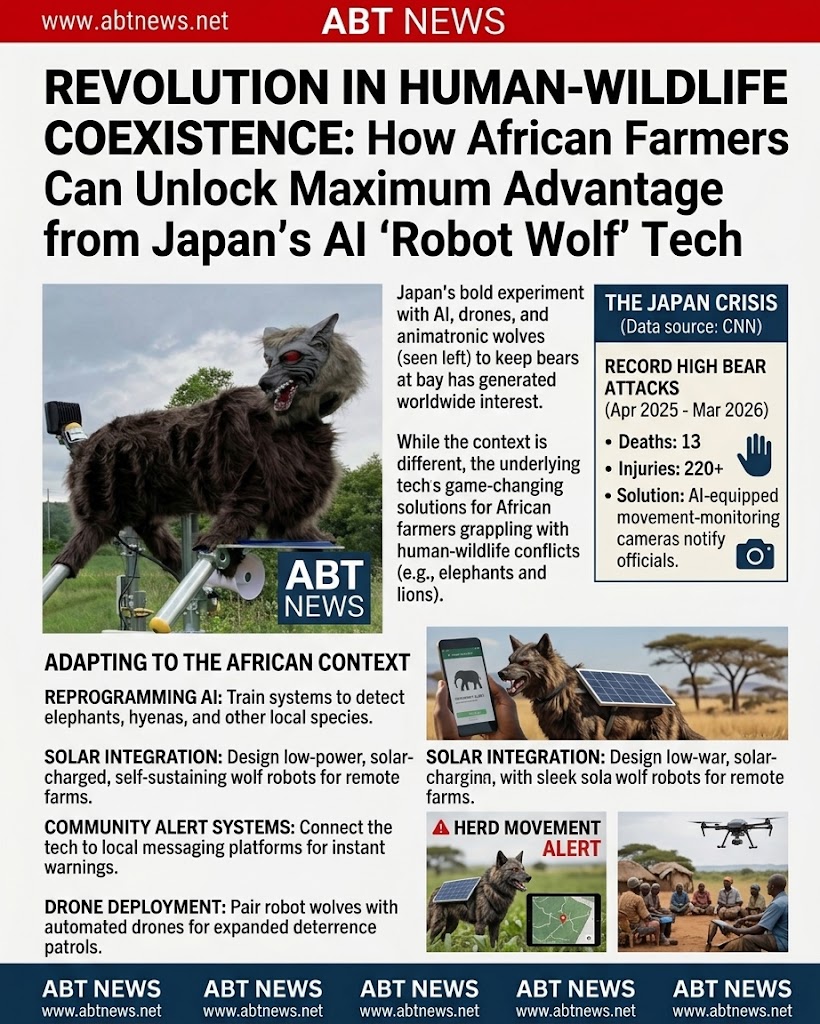
The catalyst for this technological leap comes from an alarming crisis in Japan. Between April 2025 and March 2026, the country recorded an unprecedented high in bear attacks, resulting in 13 tragic deaths and over 220 injuries. In response, regions prone to these bear encounters have started equipping the forests that surround residential areas with movement-monitoring cameras. These cameras utilize sophisticated AI to identify bears and instantly notify local officials.
But the crown jewel of this deterrence strategy is the “Monster Wolf”—a robotic, solar-powered wolf equipped with flashing LED eyes, motion sensors, and a repertoire of terrifying sounds, supported by drones to keep bears at bay.
Adapting the Tech: The African Agricultural Context
While African farmers may not face a bear crisis, the underlying challenge of human-wildlife coexistence is profoundly familiar. Elephants devastating seasonal harvests, or lions and hyenas threatening livestock, cost the continent’s agricultural sector millions annually while endangering human lives. Traditional mitigation methods: ranging from chili fences to night watches are labor-intensive and increasingly circumvented by intelligent wildlife.
By adopting and localizing Japan’s “Robot Wolf” and AI-monitoring ecosystem, African farmers can transition from reactive defense to proactive, automated deterrence.
How African Farmers Can Unlock Maximum Advantage
To keep yields high and communities safe, here is how this Japanese tech can be tailored for the African continent:
- AI Reprogramming for Local Predators: The AI algorithms driving Japan’s monitoring cameras can be retrained. By feeding the AI data on local species, these systems can be calibrated to accurately detect the distinct movement patterns and heat signatures of elephants, hyenas, leopards, and lions, preventing false alarms from harmless wildlife.
- Solar Integration & Self-Sustainability: Many African farms are remote and operate off-grid. The animatronic deterrents and AI cameras must be designed with high-efficiency solar panels and durable batteries. This ensures the “Robot Wolves” and monitoring stations remain fully operational year-round without relying on unstable power grids.
- Community-Centric Alert Systems: While Japan’s system notifies local officials, the African adaptation should integrate directly with community messaging platforms. When a predator or herd is detected, the AI can instantly dispatch SMS or WhatsApp “Herd Movement Alerts” to local farmers’ mobile devices, allowing them to secure livestock before the threat arrives.
- Drone Patrol Deployment: Stationary robot wolves can only cover so much ground. By pairing these ground units with automated, AI-driven drones, farmers can expand their deterrence patrols over vast grazing lands. Drones can emit high-frequency sounds or flashing lights to safely redirect migratory herds away from vulnerable crop yields.
The Future of Farming is Here
The intersection of AI, robotics, and agriculture is opening doors to sustainable farming practices that protect both human livelihoods and vital wildlife populations. By looking at Japan’s bold experiment, African farmers have the opportunity to embrace these cutting-edge tools, ensuring that the future of agriculture on the continent is safer, smarter, and infinitely more productive.
Stay tuned to ABT NEWS (www.abtnews.net) for more exclusive insights into the technologies transforming our world.



 By
By