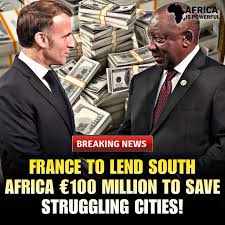

France has announced a €100 million loan package aimed at supporting struggling cities in South Africa, a nation widely regarded as the continent’s most industrialised and economically advanced. The financing, confirmed through international development channels, is designed to help municipalities facing mounting infrastructure pressures, service‑delivery challenges, and widening inequality.
The loan comes at a time when several South African cities — including Johannesburg, Tshwane, and eThekwini — are grappling with deteriorating public services, rising debt burdens, and the long-term effects of economic stagnation. While South Africa remains Africa’s richest country by GDP, many of its urban centres have struggled to maintain essential services such as water, electricity, sanitation, and transport.

A Strategic Intervention for Urban Stability
According to publicly available reports, the French government is extending the loan through its development finance institutions to help stabilise municipal finances and strengthen long-term urban planning. The funds are expected to support:
- Infrastructure rehabilitation
- Improved municipal governance
- Urban resilience programmes
- Service‑delivery upgrades in low‑income communities
French officials have framed the initiative as part of a broader commitment to supporting African economic stability and sustainable development.
Why South Africa’s Cities Are Under Pressure
Despite its economic size, South Africa faces deep structural challenges. Years of underinvestment, governance failures, and rising operational costs have left many cities unable to meet the needs of rapidly growing populations. Load shedding, water shortages, and declining revenue collection have further strained municipal budgets.
Urban economists note that strong cities are essential for national economic recovery, making international support both timely and strategically important.
A signal to Global Partners
The loan also signals renewed international confidence in South Africa’s long-term prospects. Analysts say the move could encourage other global partners to increase development financing, particularly in areas such as:
- Renewable energy
- Transport modernisation
- Housing and urban planning
- Digital infrastructure
For African economies more broadly, the development highlights the increasing role of bilateral financing in stabilising key markets and supporting urban transformation.
ABT NEWS Analysis: Implications for Africa
For the rest of the continent, France’s intervention underscores a critical reality: even Africa’s strongest economies require targeted support to maintain urban resilience. As cities across Africa expand at unprecedented rates, sustainable financing models will become increasingly important.
The development also raises questions about how African governments can strengthen municipal governance, attract investment, and build long-term resilience without overreliance on external loans. Many other African countries including Nigeria are all over the world scouting for loans.

 By
By