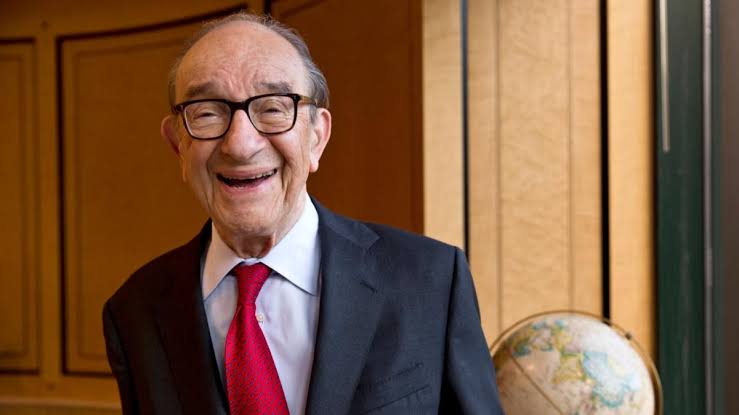

WASHINGTON — Alan Greenspan, the towering and influential economist who steered United States monetary policy for nearly two decades as chairman of the Federal Reserve, died Monday. He was 100.
Greenspan passed away at his home from complications of Parkinson’s disease, according to a statement released by his wife of 29 years, NBC News correspondent Andrea Mitchell.
“He was a giant of a man who helped shape the U.S. economy for decades under presidents of both parties, but was always honest in acknowledging his mistakes,” Mitchell wrote in her statement. “To me he was my husband, who shaped my life from our very first date in 1984. He had ‘irrational exuberance’ for baseball, the Washington Commanders, tennis, golf, and music, especially jazz. He will be remembered for his brilliance and his kindness.”
Appointed by President Ronald Reagan in 1987, Greenspan led the central bank through the end of the Cold War, the 1987 stock market crash, the dot-com boom, and the aftermath of the Sept. 11 attacks. He ultimately served under four presidents — Reagan, George H.W. Bush, Bill Clinton, and George W. Bush — before retiring in 2006.
The Era of “Greenspeak”
During his tenure, Greenspan was celebrated as an economic “Maestro” and an “Oracle.” His famously cryptic congressional testimonies, often dubbed “Greenspeak” or “Fedspeak,” were intensely scrutinized by global financial markets for any hints about the direction of interest rates.
Under his leadership, the U.S. economy experienced a breathtaking 10-year expansion from 1991 to 2001, marked by robust growth and historically low inflation. He championed free-market economics and believed deeply in the power of financial deregulation.
However, his legacy became heavily debated in the years following his departure. Critics argued that the Fed’s decision to keep interest rates low in the early 2000s, combined with his hands-off approach to regulation, helped fuel the housing bubble that eventually triggered the 2008 global financial crisis.
In a notable 2008 congressional hearing following the collapse, Greenspan admitted he had “found a flaw” in his free-market ideology and expressed distress over the crisis, though he maintained that no regulator was smart enough to foresee the “once-in-a-century credit tsunami.”
From Jazz Musician to Economic Giant
Before he was an architect of global finance, Greenspan was a musician. Born on March 6, 1926, in the Washington Heights neighborhood of New York City, he initially pursued a career in the arts. He attended the Juilliard School and played the clarinet and saxophone in a touring jazz band before shifting his focus to economics, eventually earning his Ph.D. from New York University.
Career Milestones
1974 Council of Economic Advisers
Served as chairman of the Council of Economic Advisers under Presidents Richard Nixon and Gerald Ford until 1977.
1987 Takes the Helm at the Fed
Nominated by President Ronald Reagan to succeed Paul Volcker as the 13th Chairman of the Federal Reserve.
1996 Irrational Exuberance
Delivers a famous speech warning of “irrational exuberance,” coining a phrase that perfectly captured the runaway investor enthusiasm driving up asset prices during the dot-com boom.
2006 Retirement
Steps down from the Federal Reserve after 18 and a half years, capping off the second-longest tenure in the institution’s history.
It pays to advertise your business, products and services on ABT NEWS www.abtnews.net. Please send your enquiries to advertise@abtneews.net or +447918790290


 By
By