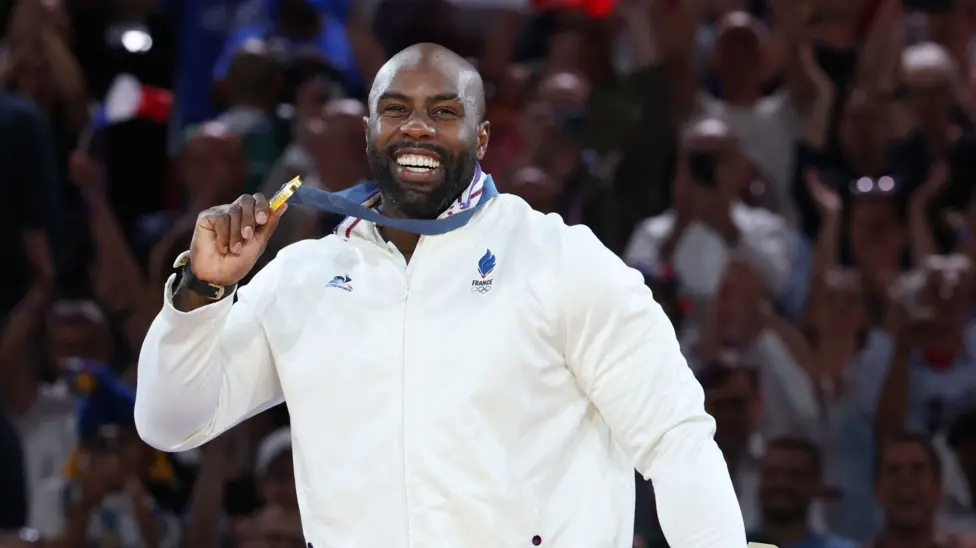

PARIS — Five-time Olympic champion Teddy Riner, widely regarded as one of France’s most popular athletes, has thrown his hat into the ring for next April’s presidential election. Entering the race with no political party, no experience in public office, and no formal manifesto yet, the 37-year-old heavyweight judoka has immediately disrupted the French political landscape.
Who Is Teddy Riner, and Where Are His Roots?
Born Teddy Pierre-Marie Riner on April 7, 1989, in Pointe-à-Pitre, Guadeloupe—a French overseas region in the Caribbean—Riner moved with his family to Paris during his early childhood, growing up in the La Chapelle neighborhood.
His deep ties to Guadeloupe remain central to his public identity. His father, Moïse Riner, hails from the commune of Vieux-Habitants, while his mother, Marie-Pierre Melgard, is originally from Lamentin. According to French sports profiles, his parents took on financial loans and made significant personal sacrifices to fund his early training. On the tatami, Riner went on to build an unmatched record—five Olympic gold medals, 11 world championships, and a decade-long streak of 154 consecutive victories—alongside business ventures and executive education at Sciences Po.
A Viral Launch and Early Polling Impact
Riner unveiled his campaign on November 9 via a two-and-a-half-minute video posted across Instagram and X, filmed against a presidential backdrop of books and a French tricolor flag under the slogan La France qu’on aime (“The France we love”).
The announcement rapidly gained traction online, drawing more than 28 million views across platforms—including 14.5 million on Instagram alone. Within 24 hours, an Ifop survey indicated that 22% of respondents said they “could” consider voting for him, though pollsters note that no confirmed first-round voting-intention figure has yet been established.
Running as the Anti-Establishment Outsider
Riner has framed his candidacy around his status as an outsider who understands everyday life better than career politicians in Paris. In his launch address, he leaned into direct, populist rhetoric to preempt criticism of his lack of political credentials:
“People say I am a fool for wanting to run for the presidency. Am I a fool? Well, if refusing to see France sink under the weight of debt; refusing to see mothers and fathers grit their teeth every time they do their weekly shop, and tremble with fear when their kids go out on the street… if all that means being a fool, then yes, call me a fool.”
Following the broadcast, Riner made an early campaign stop at a hospital in the northern Paris suburb of Seine-Saint-Denis. In interviews with Le Parisien, he positioned himself as “neither left, nor right,” stating his goals include uniting a divided nation, reducing national debt, narrowing the gap between gross and net pay, and addressing public safety concerns. He has also explicitly distanced himself from outgoing President Emmanuel Macron, describing Macron’s public welcome of his candidacy as a “poisoned chalice”.
Reactions Across the French Political Spectrum
The timing of Riner’s entry coincides with a period of uncertainty in French politics. According to AFP reporting, current surveys place hard-right leader Marine Le Pen and hard-left figure Jean-Luc Mélenchon in position for a potential second-round runoff in May, while the political center remains fragmented without a single dominant standard-bearer.
- Cautious Recognition from Rivals: Established politicians have largely avoided mocking Riner, mindful of his broad public goodwill. During a campaign stop, Marine Le Pen offered a measured response, stating she could not form an opinion on his candidacy until he releases a concrete policy platform.
- Skepticism from Political Analysts: Commentators remain divided on whether Riner’s celebrity can translate into ballot-box durability. Guillaume Tabard of Le Figaro noted that while being outside the political establishment is no longer a disqualifier, “not belonging to the in-crowd” is not enough on its own to win the Élysée. Similarly, Erwan Lestrohan of the Odoxa polling institute told L’Équipe and AFP that Riner is “starting from zero in terms of political credibility” and must convert his “sympathy capital” into substantive policy expertise on complex issues like debt and purchasing power.
What Comes Next?
To officially appear on the April 2027 ballot, Riner must first clear a major institutional hurdle: collecting 500 formal sponsorships (parrainages) from mayors and other elected officials across France, while financing his campaign through personal funds and private donations. Remarkably, the 37-year-old has also stated he has not ruled out competing in the 2028 Los Angeles Olympic Games—even if elected—should the duties of the presidency allow it.


 By
 By