
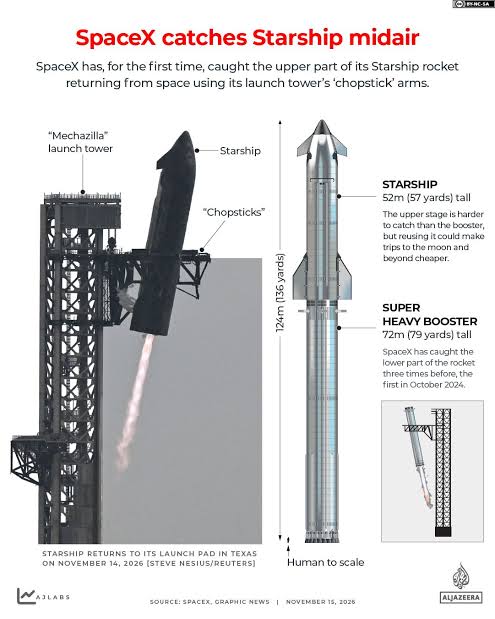

STARBASE, Texas — In a watershed moment for aerospace engineering and commercial spaceflight, SpaceX has successfully caught the upper stage of its colossal Starship megarocket in midair upon its return from orbit.
On Saturday afternoon, November 14, 2026, the stainless-steel spacecraft, designated Ship 42, plunged back through Earth’s atmosphere after completing 14 orbits and guided itself directly into the giant mechanical arms of its launch tower at Starbase in South Texas. The unprecedented maneuver marks the first time an orbital upper stage has ever been plucked out of the sky at its launch site, bringing SpaceX significantly closer to its goal of a fully and rapidly reusable space transportation system.
A High-Stakes Return From Orbit
While SpaceX had previously demonstrated midair catches of the first-stage Super Heavy booster on earlier test flights, capturing the Starship upper stage presented an exponentially harder engineering challenge. Unlike the booster, which separates minutes after liftoff, the upper stage reaches orbital velocity, flying vastly higher, farther, and faster, and must survive extreme atmospheric reentry heating before attempting a pinpoint landing.
During the final descent of Integrated Flight Test 15 (IFT-15), Ship 42 executed a precision trajectory across the North American continent before performing a sweeping terminal approach over South Texas. Relighting its Raptor engines to flip from a horizontal “belly-flop” descent into a vertical hover, the spacecraft aligned its forward catch pins with the launch tower’s Mechazilla arms—affectionately known as “chopsticks”—which closed securely around the vehicle high above the launch mount.
“We caught a Starship, and now everything changes. One of the most incredible and historic engineering feats of all time has just happened right in front of our eyes.” — SpaceX Flight 15 Broadcast Commentary
NASA Administrator Jared Isaacman praised the milestone shortly after touchdown, calling the capture “almost magic” and noting that the breakthrough brings the United States “one step closer” to returning astronauts to the lunar surface under the Artemis program.
Flight 15 Mission Breakdown: Triumph After Early Booster Setback
The dramatic Saturday capture followed a tense 22.5-hour mission that began on Friday, November 13, at 5:47 p.m. EST. SpaceX had originally aimed for an ambitious “double catch” of both rocket stages during Flight 15, though an automated safety abort prevented the booster recovery.
| Mission Milestone | Flight 15 Outcome & Details |
| Liftoff | Launched Friday, Nov. 13 at 5:47 p.m. EST from Starbase, Texas; all 33 Super Heavy Raptor engines ignited cleanly. |
| Super Heavy Booster | 32 of 33 engines lit for the boostback burn; the Guidance, Navigation, and Control (GNC) system detected an off-nominal trajectory and triggered an automated abort, diverting the booster to an offshore splashdown in the Gulf of Mexico. |
| Orbital Payload | Ship 42 reached orbit cleanly and successfully deployed 26 Starlink satellites. |
| Upper Stage Reentry | Completed 14 orbits over ~22.5 hours, executed a 10-second deorbit burn, and withstood peak reentry plasma. |
| Tower Catch | Caught cleanly by the Starbase Mechazilla chopsticks at approximately 4:20 p.m. EST on Saturday, Nov. 14. |
Why the ‘Chopsticks’ Catch Matters for Moon and Mars Travel
Conventional rockets either discard their upper stages to burn up in the atmosphere or rely on heavy landing legs and parachutes that require extensive post-flight refurbishment. By eliminating landing gear on the spacecraft and transferring that structural mass to the ground-based launch tower, SpaceX maximizes Starship’s payload capacity to orbit.
Recovering Ship 42 intact—without exposure to corrosive ocean saltwater—allows SpaceX engineers to perform immediate forensic inspections on its upgraded thermal protection heat shield tiles and internal systems. Mastering rapid turnaround for both Super Heavy and Starship is the cornerstone of SpaceX’s roadmap for orbital propellant depots, NASA’s Artemis lunar landers, and high-cadence missions to Mars.
For continuing coverage on space exploration, aerospace breakthroughs, and deep-tech innovation, stay tuned to ABT NEWS at www.abtnews.net.

Your donations help us to maintain our independence and sustain our professionalism. Please use the link https://www.paypal.com/ncp/payment/XZ4UUNUEEM9K4 Thanks in advance for your generosity


 By

 By