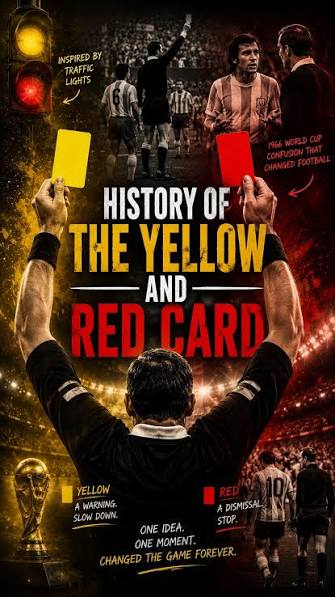

How a fiery 1966 World Cup clash, a stubborn Argentine captain, and a London traffic stop birthed the universal language of the beautiful game.
The yellow and red cards are perhaps the most universally recognized symbols in global sports today. Whether you are playing in a high-stakes World Cup final or a Sunday league match at the local park, the meaning is identical and absolute: caution or expulsion. Yet, this brilliantly simple, universally understood system wasn’t born in a high-level corporate boardroom, nor was it meticulously planned by football’s early rule-makers. It was the product of complete on-pitch chaos, a bitter clash of languages, and a serendipitous drive through the streets of London.
The story begins on July 23, 1966, at the hallowed grounds of Wembley Stadium. England and Argentina were facing off in the quarter-finals of the World Cup. Stakes were astronomically high, and the atmosphere was heavily charged before the first ball was even kicked. From the opening blow of the referee’s whistle, it was a bad-tempered match marred by intensely physical play and overt hostility.
The defining moment arrived in the 35th minute. German referee Rudolf Kreitlein made the bold decision to send off the imposing Argentine captain, Antonio Rattín. The situation immediately devolved into a farce. The official reason provided for the dismissal was “violence of the tongue”—a highly curious accusation given that Kreitlein spoke no Spanish, and Rattín spoke neither German nor English. Some subsequent accounts suggested that the expulsion might have been triggered by nothing more than a “dirty look” directed at the official.
“For nearly ten minutes, the match was held up as Rattín argued, teammates swarmed the referee, and FIFA officials desperately tried to intervene.”
Feeling severely wronged by what he perceived as a massive injustice, Rattín flatly refused to leave the pitch. The match was entirely suspended. For nearly ten agonizing minutes, chaos reigned supreme. Teammates furiously swarmed the referee, demanding an explanation that couldn’t be communicated, while bewildered FIFA officials rushed onto the field to mitigate the disaster.
Ken Aston, the English head of the tournament’s referees committee, eventually had to physically wade into the melee to calm the escalating situation. Ultimately, police officers were summoned onto the pitch to escort the defiant Argentine captain away.
Rattín did not go quietly. In a final, unforgettable act of defiance, he marched over to the Royal Box and deliberately sat down on the red carpet reserved exclusively for Her Majesty the Queen. As he was finally escorted down the tunnel, he aggressively wrinkled a corner flag bearing the English pennant in his hands, cementing the match’s infamy.
England eventually won the brutal contest 1-0 and would famously go on to win the entire tournament. However, the most enduring legacy of that fateful afternoon was born shortly after the final whistle, on a quiet drive home.
Ken Aston left Wembley with the day’s pandemonium still racing through his mind. The fundamental problem, he realized, was communication. Football was an international game, but it was being refereed in local dialects. How could a referee clearly communicate a warning or an expulsion to a player, the roaring crowd, and the global media, regardless of what language they spoke?
As Aston drove down Kensington High Street, he rolled to a stop at a traffic light. He stared out his windshield as the lights shifted from green, to yellow, to red. In that mundane, everyday moment, an epiphany struck him.
“Colors that every person on earth already understood, regardless of language. Yellow: take it easy. Red: you’re off.”
It was a stroke of pure genius in its simplicity. Aston took the idea to FIFA, arguing convincingly that language barriers were threatening the integrity and safety of the sport. The governing body agreed. Four years later, at the 1970 World Cup in Mexico, the yellow and red card system was formally introduced. It was an instant success, bringing immediate clarity and undeniable authority to the referee’s pocket.
Today, the system has been adopted in every World Cup since and is utilized in virtually every professional football competition on the planet—a lasting tribute to a brilliant idea sparked by a London traffic light and one incredibly stubborn football captain.
© 2026 ABT NEWS (www.abtnews.net). All Rights Reserved.



 By
By