
ABT NEWS | SPECIAL REPORT www.abtnews.net
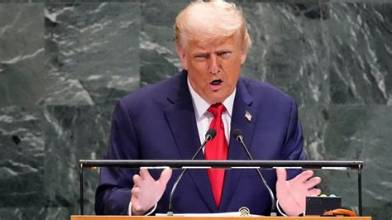
NEW YORK — World leaders gathered at the United Nations General Assembly (UNGA) in New York were met with a dramatic shift in technological discourse when U.S. President Donald Trump apart from declaring himself as World’s greatest peacemaker, also disclosed that the United States government will officially drop the term “Artificial Intelligence” (AI) in favor of “Super Intelligence” (SI).
Addressing the assembly floor, Trump rejected international calls for tech safeguards, framing the race for advanced machine learning as a high-stakes, winner-take-all competition between the United States and China
1. What Should You Be Aware of at UNGA This Year?
The 2026 High-Level Week at the UN General Assembly has exposed a sharp divide between international governance bodies and Washington regarding the future of emerging technologies:
- UN Security & Governance Push: UN Secretary-General António Guterres opened the assembly by calling for mandatory international oversight on advanced algorithms, warning against weaponized AI and “killer robots” operating without human accountability.
- The U.S. Refusal: President Trump explicitly rejected global safety frameworks, labeling international regulation attempts a “globalist scheme” designed to slow down American industry.
- Economic & Infrastructure Mandate: The U.S. administration reiterated its push to aggressively build out domestic data centers and energy infrastructure, projecting that the technology sector could eventually represent up to 25% of U.S. GDP.
2. What Did Trump’s UNGA Speech Mean?
Trump’s address signals a complete pivot in U.S. tech policy—moving away from cautious regulation toward uninhibited acceleration:
“Whoever wins AI and now I say, whoever wins SI, whoever wins super intelligence, wins everything. We are leading now over China by a lot, and we’re going to keep it that way.”
— Donald Trump, addressing the UN General Assembly
- Rejection of Existential Warnings: Trump dismissed warnings from scientists, AI executives, and global leaders that advanced AI systems pose existential risks to humanity, calling such concerns a “hoax” akin to political controversies.
- Prioritizing Strategic Lead over Safety Regimes: The U.S. position makes clear that Washington will not sign treaties or frameworks restricting algorithmic development, arguing that imposing guardrails on domestic companies would hand an advantage to foreign competitors like Beijing.
- Internal Oversight Only: Rather than supporting a new international agency, Trump stated that the U.S. Department of Justice would monitor commercial entities under existing laws without stifling growth.
3. Why Change “Artificial Intelligence” to “Super Intelligence”?
Trump explained his rationale for the nomenclature change during his address and through prior online posts:
- The Word “Artificial”: Trump argued that the word “artificial” carries negative connotations, making machine capability sound “fake” or “ineloquent” when the technology is, in his words, “actually amazing.”
- Public Benchmarking: The announcement followed a series of public polls Trump hosted over the weekend on Truth Social and X, asking followers to choose between names like “Superior Intelligence”, “Extreme Intelligence”, and “Super Intelligence”.
- Federal Mandate: Trump directed that effective immediately, all official federal U.S. government documents, contracts, and policies will use “Super Intelligence” or “SI”. He also reiterated plans to form an “AI Force” (or “SI Force”) structured similarly to the U.S. Space Force.
4. Will the World Accept the Name Change?
| Sector | Expected Adoption | Analysis |
| U.S. Federal Agencies | Immediate | Executive orders dictate official terminology across federal grantmaking, military contracts, and government documentation. |
| Scientific Community | High Resistance | Computer scientists reserve Superintelligence (ASI) for theoretical systems exceeding human performance across all domains. Applying it to existing models clashes with established academic nomenclature. |
| United Nations & EU | Unlikely | International treaties, European regulation (such as the EU AI Act), and UN documentation will likely maintain standard legal definitions like “Artificial Intelligence”. |
| Tech Industry & Marketing | Mixed / Strategic | U.S. defense contractors and commercial tech vendors seeking federal grants will adopt “SI” for government bids, while consumer brands may stick with standard terminology. |
https://www.profitableratecpmnetwork.com/ubczxv0mw2?key=b2e5edaf3d3885ea2edecf68be90ad44


 By
By