
When companies achieve consistent profitability, they face a pivotal strategic choice: hoard cash, reinvest in operations, or share their success directly with the investors who funded them. For long-term investors, that third option: dividends, remains one of the most reliable wealth-generation tools in modern finance.
As highlighted in a recent commentary by investment authority Afrinvest, dividend payouts serve a dual purpose in corporate finance: they reward existing shareholders for committing capital while simultaneously signaling financial stability to attract new investors.
However, cash payouts are only half the story. The true magic occurs when investors harness the power of compounding by automatically reinvesting those dividends to purchase additional shares.
Verified Facts: The Historical Weight of Dividend Reinvestment
While share price appreciation dominates headline news, historical data from global markets demonstrates that dividends contribute the majority of total long-term stock market returns.
According to research from Hartford Funds analyzing S&P 500 Index data from 1960 through 2025, an astounding 85% of the total cumulative return of the index was driven by reinvested dividends and the power of compounding. On an average annual basis, dividend income contributed approximately 33% of total equity returns over the same multi-decade span.
| Investment Scenario (S&P 500: 1928–2021) | Initial Capital | Final Portfolio Value | Annualized Compound Growth |
| Price Appreciation Only (No Dividends) | $1,000 | $258,383 | 6.1% per year |
| Dividends Paid in Cash (Not Reinvested) | $1,000 | $380,250 | 6.5% per year |
| Dividends Reinvested (Compounded) | $1,000 | $7,008,076 | 9.9% per year |
Source: Welch & Forbes long-term market return study.
As the data shows, an investor who took dividend cash payouts earned $380,250 on a $1,000 investment over 93 years. But the investor who reinvested those dividends turned that exact same $1,000 into over $7 million—a difference of more than 18x purely due to dividend compounding.
How Dividend Compounding Works: The “Snowball” Effect
Compounding is often called the eighth wonder of the world because growth accelerates non-linearly over time.
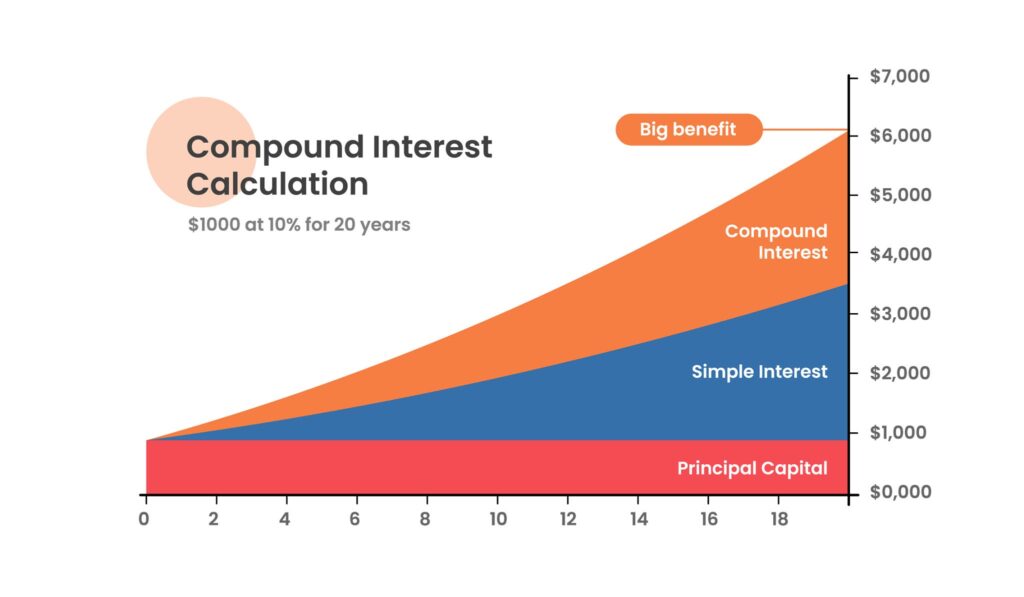
When you hold shares in a profitable company that pays dividends, the cycle follows a powerful flywheel:
- Earnings & Payouts: The company generates profits and pays a dividend per share.
- Reinvestment: You use that cash payout to automatically buy more shares (or fractional shares).
- Larger Share Base: On the next payout date, you own more shares than before.
- Exponential Payouts: Because you own more shares, your next dividend check is bigger—even if the company doesn’t raise its per-share dividend payout rate.
- Accelerated Growth: If the company also grows its dividend over time (a “Dividend Aristocrat”), your yield on initial cost expands rapidly.
Interactive Tool: Model Your Dividend Compounding Potential
Use this interactive simulator to see how adjusting your initial investment, dividend yield, and reinvestment horizon transforms long-term wealth outcomes:
Key Takeaways for Smart Investors
- Consistent Profits Matter: Prioritize companies with stable earnings, sustainable dividend payout ratios (ideally under 60%), and strong cash flows rather than chasing artificially high, unsustainable yields.
- Turn On DRIP: Enrolling in a Dividend Reinvestment Plan (DRIP) automates fractional share purchases without transaction fees, ensuring zero cash drag.
- Start Early: Time in the market is the fuel for compounding. The exponential curve grows steepest in years 15 through 30.



 By
By