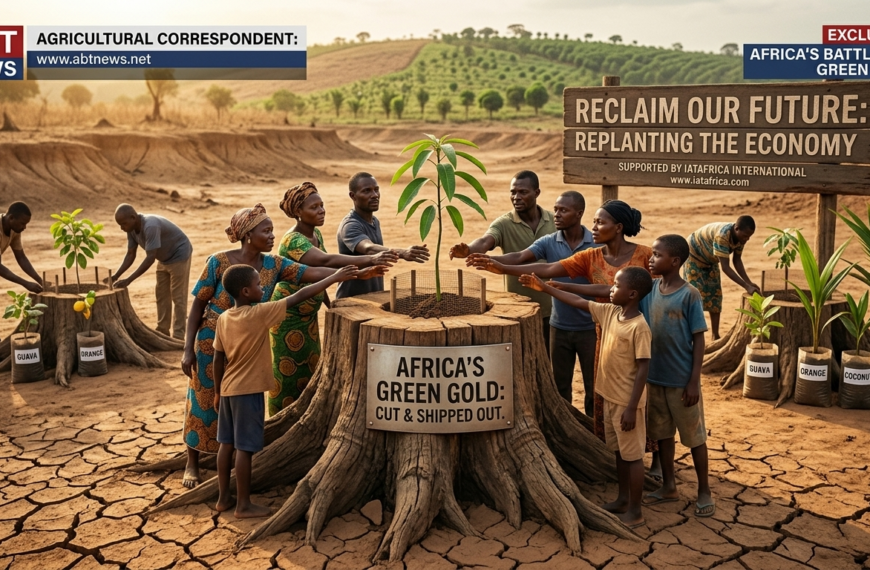

LIVERPOOL, UK – In a shocking scientific breakthrough that has sent shockwaves through the global agricultural market, a British biotech firm has unveiled a massive, state-of-the-art facility in Merseyside designed to do the unthinkable: completely replace natural palm oil with a laboratory-grown alternative.
The Clean Food Group, backed by heavy-hitting investment firm Agronomics, has officially rescued a sprawling manufacturing facility in Liverpool, transforming it into one of the largest “precision fermentation” plants on the planet. Their weapon of choice? A genetically “trained” super-yeast that literally brews palm oil inside giant vats, using a process shockingly similar to brewing beer!
For decades, palm oil has been the world’s most ubiquitous and controversial ingredient, hiding in over 50% of all supermarket products, from peanut butter and frozen pizzas to lipsticks and soaps. But its production has long been plagued by accusations of rainforest devastation, habitat loss for endangered orangutans, and massive carbon emissions.
Now, Western scientists claim they have found the ultimate “get out of jail free” card. By bypassing tropical plantations entirely, this Liverpool mega-plant aims to wipe out a staggering 7% of the UK’s total palm oil demand right out of the gate.
Supporters are hailing this as a “miracle technology” that will save the planet’s remaining rainforests. But beneath the eco-friendly celebration lies a terrifying economic reality. This “Frankenstein oil” could trigger an absolute apocalypse for developing nations whose economies are completely tethered to the natural palm oil trade.
Are we witnessing the death of the traditional plantation? Will millions of farmers across Asia and Africa be plunged into poverty by a yeast brewed in a British factory? One thing is certain: the global food war has officially begun.
DEEP-DIVE ANALYSIS: What This Means for Palm Oil Producing Countries
The rise of precision-fermented synthetic palm oil in Western laboratories represents a paradigm shift in global agricultural trade. While the technology is currently in its scaling phase, its commercialization poses unique strategic threats—and rhetorical battlegrounds—for the world’s major palm oil producers: Indonesia, Malaysia, and Nigeria.
1. Indonesia & Malaysia: The Threatened Giants
Together, Indonesia and Malaysia control roughly 85% of the global palm oil supply. For these nations, palm oil is not just a crop; it is a massive driver of GDP, a major source of foreign exchange currency, and the primary livelihood for millions of smallholder farmers.
- The Export Threat: Europe and the UK have historically been the most aggressive markets regarding anti-deforestation legislation (such as the EU Deforestation Regulation – EUDR). If synthetic palm oil gains regulatory approval and reaches price parity, UK and European consumer goods giants (like Unilever or Nestlé) will eagerly switch to lab-grown alternatives to satisfy eco-conscious consumers and domestic regulations. This could cause a sharp decline in premium-paying export markets for Indonesia and Malaysia.
- The Smallholder Crisis: Corporate plantations might survive a price dip, but millions of independent smallholders in Sumatra, Borneo, and Peninsular Malaysia cannot. A major drop in global demand could trigger widespread rural poverty and political instability.
- The Counter-Strategy: Organizations like the Council of Palm Oil Producing Countries (CPOPC) will likely fight back by targeting the energy footprint of precision fermentation. Brewing oil in massive bioreactors requires immense amounts of electricity. Malaysia and Indonesia will argue that natural oil palm trees utilize free solar energy and capture carbon natively, making them highly efficient. Expect these nations to double down on national sustainability certifications (MSPO and ISPO) to market their product as the “natural, energy-efficient choice” against Western “factory-made” oils.
2. Nigeria: The Domestic Insulator
Nigeria’s relationship with palm oil is fundamentally different from its Southeast Asian counterparts. Once the world’s largest producer, Nigeria is now a net importer, utilizing its production almost entirely for domestic consumption to feed its rapidly growing population of over 200 million people.
- Immediate Shielding from Western Shocks: Because Nigeria does not rely heavily on exporting palm oil to Europe, a lab-grown alternative in Liverpool will not immediately collapse the Nigerian domestic market. The local demand for technical and crude palm oil (CPO) for cooking and local manufacturing remains fiercely high.
- The Long-Term Threat to Industrialization: Nigeria has been actively trying to revitalize its agricultural sector to reduce reliance on crude oil and save foreign exchange. The Central Bank of Nigeria has previously poured billions of Naira into upgrading domestic palm oil estates. If synthetic palm oil scales globally and eventually becomes cheaper than farming, it could completely disincentivize foreign and domestic investments into Nigeria’s agricultural infrastructure.
- The Risk of “Dumping”: If European markets reject natural palm oil in favor of lab-grown alternatives, global supply dynamics will shift. Southeast Asian producers may “dump” their excess natural palm oil into African markets at ultra-low prices, undercuting Nigerian local farmers who operate at higher production costs.
The Ultimate Verdict
While precision fermentation is highly promising, nature still holds a massive advantage: yield efficiency. The oil palm tree is the highest-yielding oil crop on earth, producing up to four times more oil per hectare than sunflower or rapeseed.
For Malaysia, Indonesia, and Nigeria, the immediate threat is not an overnight collapse, but a branding and regulatory war. Western lab-grown alternatives will dominate premium markets looking for “deforestation-free” labels, forcing traditional producing countries to either radically clean up their environmental supply chains or pivot their exports entirely toward less restrictive markets in India, China, and domestic African sectors.
Stay glued to ABT NEWS www.abtnews.net for the latest breaking news and trending news. Advert enquiries should be sent to info@abtnews.net or call +447918790290 or +2349066106786


 By
By