


By ABT NEWS Editorial Board | www.abtnews.net
Nigeria is the undisputed global titan of yam cultivation, churning out millions of metric tons annually and dwarfing the rest of the world’s production combined. Yet, in a staggering display of economic self-sabotage and maximum folly, the nation is practically handing over its export wealth to neighbouring Ghana. So unbelievable!
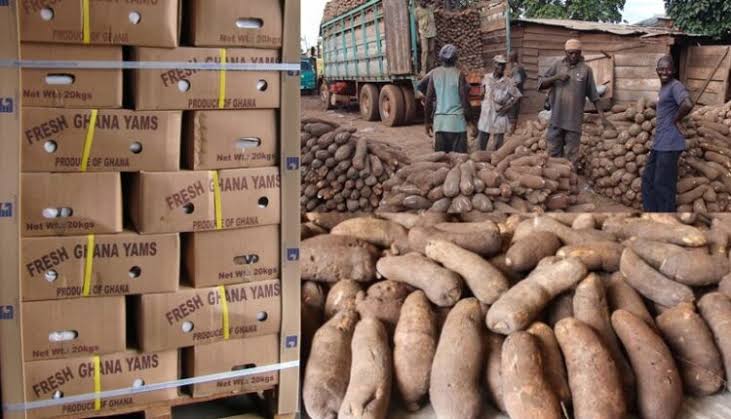
A damning reality has been exposed at the heart of West Africa’s agricultural supply chain: Nigerian yams are being aggressively bought up by opportunistic Ghanaian traders, funneled through Ghana’s highly optimized export infrastructure, and shipped off to lucrative European and international markets.
The label on those premium-priced boxes? Product of Ghana. WOW! Ghana is simply nicking our lunch under our very nose!

This is not a story of Ghanaian malice; it is a glaring indictment of Nigerian logistical paralysis and a catastrophic failure in agricultural business development. It has now been established after an extensive ABT NEWS investigation that Ghana achieved total dominance in commercial yam exports not by out-farming Nigeria, but by entirely outclassing it in the crucial final miles of the commodity value chain.
While Nigerian produce is left vulnerable to post-harvest losses in chaotic local markets, Ghana has mastered the mechanics of global trade. Their advantage lies in rigorous international certification, superior packaging, stringent quality control, and seamless supply-chain coordination. They are executing the fundamental principles of value addition that Nigeria continues to ignore.
For a nation desperate for foreign exchange, economic diversification, and sustainable wealth creation, this failure to capture the international export value of its own indigenous crop is an absolute tragedy. Why is the world’s largest yam producer content with doing the backbreaking labour, only to watch a neighbouring country reap the premium international profits?
The answer points to a profound systemic rot. It exposes a landscape where policymakers and agribusiness leaders have wholly neglected the infrastructure required for modern export processing. Growing the crop is only 10% of the battle; securing the packaging, meeting stringent European phytosanitary safety certifications, and coordinating complex logistics is where the real money is made.
Until massive structural reforms are implemented to fix these broken supply chains, Nigeria will remain a giant with feet of clay, doing all the heavy lifting in the dirt, while its neighbours smile all the way to the bank. This is no longer just an agricultural oversight; it is an active hemorrhaging of national wealth. Gbaam!


 By
By










Very sad development for Nigeria! Africa needs to wake up!
THE YAM PARADOX: BLAME NOT GHANA — BLAME OURSELVES!
By Boniokoye Imegwu
The substance of this disturbing report is largely true, although I would hesitate to call it a Ghanaian “yam heist.”
Nigeria is indeed the world’s colossus of yam production.
We produce roughly 65 million tonnes annually — around 70 per cent of the world’s crop — compared with Ghana’s approximately 11 million tonnes.
Yet Ghana has comprehensively beaten us where it matters commercially: getting the yam from the farm into the international marketplace!
The contrast is almost embarrassing. Recent international trade figures indicate that Ghana exports tens of thousands of tonnes of yam annually, while Nigeria — despite producing several times more — officially exports only a minute fraction of that quantity.
So, yes, there is a Nigerian yam scandal.
But Ghana is not the villain!
There have long been reports of Nigerian-grown yams crossing our borders into Ghana and subsequently entering international trade through Ghanaian export channels.
That deserves proper investigation, particularly where the true country of origin may be misrepresented.
But we should be careful about claiming, without compelling evidence, that Ghana’s extraordinary yam-export performance depends substantially upon Nigerian produce.
Ghana is itself the world’s second-largest producer and grows vastly more yam than it exports.
The more uncomfortable truth is therefore this:
Ghana did not steal our yam market; Nigeria practically abandoned it!
While we congratulate ourselves on being the world’s largest producer, Ghana concentrated on the less glamorous but economically decisive business of building an export value chain — grading, phytosanitary certification, traceability, storage, packaging, branding, aggregation, haulage, ports, shipping and international marketing.
The result?
Nigeria grows the yam.
Ghana sells the yam.
Nigeria celebrates production statistics. Ghana collects export earnings.
Nigeria possesses the comparative advantage; Ghana developed the competitive advantage.
That is the real scandal.
There is something fundamentally wrong with an economy that can produce approximately 70 per cent of a globally traded agricultural commodity and yet remain almost invisible on the shelves where that commodity commands its highest prices.
And yam is merely symptomatic of a larger Nigerian malaise.
For decades we have been obsessed with production without value addition: cocoa without enough chocolate; crude oil without sufficient refining; agricultural produce without processing; minerals without beneficiation; and yam without an efficient international commodity chain.
We repeatedly do the hardest and least profitable part of the work and surrender the higher-value portions of the chain to somebody else.
Ghana should therefore not be castigated for doing efficiently what Nigeria has neglected to do.
If Ghanaian exporters have identified markets in London, Amsterdam, Brussels, New York and Toronto; developed internationally acceptable packaging; organised producers and exporters; satisfied phytosanitary requirements; secured shipping arrangements and cultivated dependable relationships with foreign wholesalers, the proper Nigerian response is not indignation.
It is competition.
Nigeria already has the farmers.
It has the land.
It has the yam.
It has a huge Nigerian and West African diaspora providing a ready-made overseas market.
What it desperately needs is the machinery between farm and foreign supermarket.
Government and the private sector should therefore establish export aggregation and conditioning centres in the major yam-producing belts; standardise varieties intended for export; strengthen traceability and certification; dramatically improve storage and transport; establish dependable refrigerated and ventilated logistics where appropriate; simplify port procedures; encourage professional agricultural-export companies; and build a recognisable Nigerian Yam brand abroad.
Indeed, instead of merely exporting raw tubers, we should increasingly process yam into flour, flakes, frozen products and other higher-value derivatives suitable for African consumers abroad and potentially for wider international food markets.
There is encouraging evidence that the Nigerian Export Promotion Council has begun developing yam-export clusters and addressing certification, packaging, traceability and market access. But considering the enormous size of our production advantage, such efforts must move from isolated interventions into a coherent national export strategy.
So I broadly agree with the outrage expressed in the original article.
But I would change its accusation.
Ghana has not “hijacked” Nigeria’s yam wealth.
Ghana has simply organised itself to exploit an opportunity that Nigeria, inexplicably, has left lying by the roadside.
If some Nigerian yams cross that same road into Ghana and thereafter acquire greater commercial value, our first question should not be:
“What is Ghana doing to us?”
It should be:
“What, for heaven’s sake, are we doing to ourselves?”
That is the real Great Nigerian Yam Scandal.
(Mr Boniokoye Imegwu,
A Member of the Chartered Institute of
Logistics &Transport, writes from Reading, England)
Email: bonimegwu@gmail.com