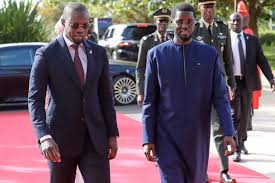

Once hailed as the unbreakable tandem of Senegalese politics, the formidable alliance between President Bassirou Diomaye Faye and Ousmane Sonko has dramatically collapsed. On May 22, President Faye dismissed his long-time political ally and mentor, Ousmane Sonko, from his position as Prime Minister, dissolving the government in a political earthquake that has stunned the whole of West Africa.
The dismissal marks the climax of months of simmering tensions between the two men, turning a historic brotherhood into a fierce institutional rivalry.
How They Got to Power: The “Diomaye is Sonko” Phenomenon To understand the magnitude of this fallout, one must look back to their historic 2024 election victory. The two men were the twin architects of the PASTEF party, with Sonko as its charismatic, anti-establishment leader and Faye as its meticulous chief strategist.
Sonko was the undisputed favorite for the presidency, but a politically charged defamation conviction barred him from running. In a masterstroke of political maneuvering, Sonko endorsed his then-imprisoned deputy, Faye, as “Plan B.” Campaigning under the rallying cry “Diomaye is Sonko,” the strategy worked flawlessly. Ten days after being released from prison, Faye won a sweeping first-round victory, becoming Africa’s youngest democratically elected president at age 44. True to their bond, Faye immediately appointed Sonko as Prime Minister, seemingly cementing a joint presidency.
What Soured the Relationship: A 132% Debt Crisis At the heart of the bitter divorce is money. Upon taking office, public audits revealed shocking levels of hidden borrowing orchestrated by the previous Macky Sall administration. Senegal’s public debt was discovered to have ballooned to a staggering 132% of its GDP—over $43 billion—leaving the nation on the precipice of financial collapse.
The two leaders fundamentally clashed over how to navigate the disaster. President Faye adopted a pragmatic, orthodox stance, desperately seeking to unfreeze a $1.8 billion lending program from the International Monetary Fund (IMF) to avoid a default. To secure the bailout, the IMF demanded painful austerity measures, including severe fuel price hikes and deep budget cuts.
Sonko, however, stayed true to his radical, sovereigntist roots. He vehemently opposed the IMF’s dictates, arguing that submitting to structural adjustments and fuel hikes would betray their populist voter base and sacrifice Senegal’s economic sovereignty. Sonko advocated for a purely domestic recovery plan driven by internal resources and pushing back against foreign financial control. The ideological rift proved fatal to their partnership.
What the Fallout Means for Senegal Faye’s dismissal of Sonko signals a decisive pivot toward technocratic governance and international financial appeasement. On May 25, President Faye appointed Ahmadou Al Aminou Lo—a highly regarded former executive at the Central Bank of West African States (BCEAO)—as the new prime minister. Lo’s immediate mandate is to form a cabinet of experts and urgently resume debt restructuring negotiations with the IMF.
However, Sonko is far from sidelined. In a stunning institutional twist on May 26, Sonko engineered a rapid comeback, becoming Speaker of the National Assembly following the sudden resignation of El Malick Ndiaye. This places the immensely popular Sonko at the helm of the legislative branch, giving him a powerful platform to check, and potentially paralyze, the President’s executive authority.
Sonko wasted no time flexing his new muscles. In his maiden speech as Speaker, he fiercely criticized the appointment of the new prime minister, condemning the President for bypassing their party in the formation of the new government.
Senegal now faces uncharted waters. The country is staring down a grueling path of economic austerity, complicated by a newly divided government. As the historic “Sonko-Faye” tandem transforms into an explosive executive-legislative rivalry, the ultimate casualty may be the stability of one of West Africa’s most resilient democracies.
Stay tuned to www.abtnews.net for more exclusive insights! Send all advertising enquiries to advertise@abtnews.net or +447918790290

 By
By