
On January 1, 2026, an era quietly ended. Warren Buffett, the legendary “Oracle of Omaha,” officially stepped down as CEO of Berkshire Hathaway after more than five decades, handing the reins to his successor, Greg Abel. Departing at age 94 with a staggering net worth of $146.5 billion, Buffett leaves behind more than just the world’s tenth-largest fortune—he leaves behind a blueprint.
But how exactly does the philosophy of an American billionaire resonate with a 25-year-old tech founder in Lagos, a brilliant creative in Johannesburg, an agri-business innovator in Accra, or an ambitious diaspora entrepreneur?
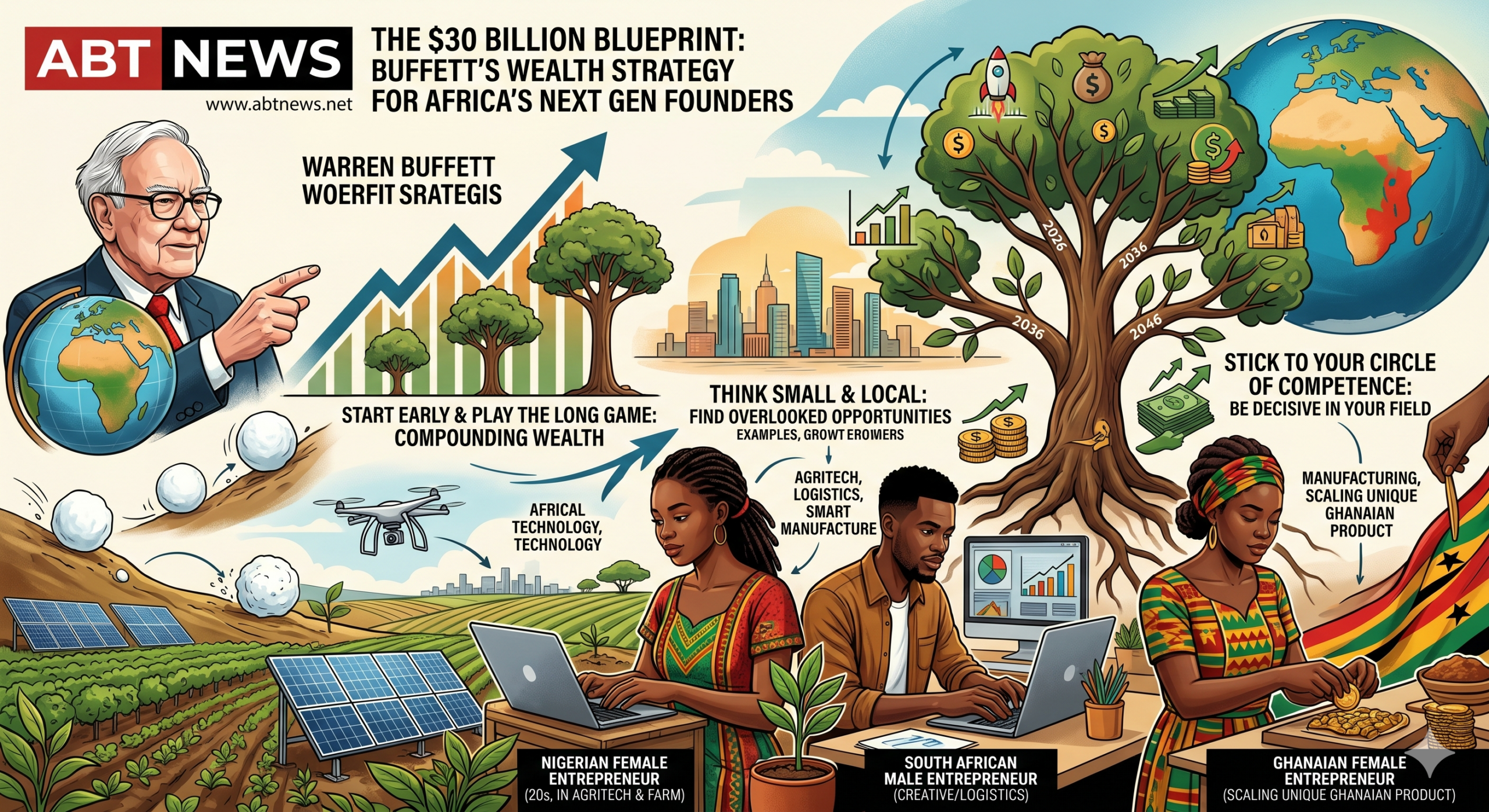
The answer lies in a legendary response Buffett gave back in 1999. When asked by a shareholder how a new investor could amass $30 billion, Buffett didn’t preach complex financial engineering. Instead, he delivered three brutally simple, universally applicable principles: Start early, think small, and stay within what you know.
For young African entrepreneurs looking to build generational wealth and shatter ceilings, this is your masterclass. Here is how to apply Buffett’s timeless advice to the African hustle.
1. The Snowball Effect: Start Early and Play the Long Game
Buffett famously bought his first stock at age 11, but the vast majority of his wealth was actually accumulated after his 65th birthday. He described compound interest as a snowball rolling down a hill.
“I started building this little snowball at the top of a very long hill. The trick to having a very long hill is either starting very young or living to be very old.”
The African Context: Africa boasts the youngest population in the world. Time is your greatest, most unparalleled asset. However, the pressure to “blow up” overnight often pushes young founders into unsustainable burn rates or short-term thinking.
Buffett’s message is clear: Stop looking for the overnight miracle. Whether you are building a fintech app in Nigeria or a logistics network in South Africa, focus on laying a foundation that can compound over decades. Small, consistent daily improvements in your business model, customer retention, and personal skills are the “snowflakes” that will eventually create an unstoppable avalanche of wealth.
2. Think Small to Win Big: Hunt for Overlooked Opportunities
Buffett told his audience that if he were starting all over again with just $10,000, he wouldn’t chase the biggest, flashiest companies.
“I probably would be focusing on smaller companies because I would be working with smaller sums and there’s more chance that something is overlooked in that arena,” he advised.
The African Context: African startup media is obsessed with “unicorns”—companies valued at over $1 billion. But as an early-stage entrepreneur, your goldmine is in the overlooked, “unglamorous” sectors.
Look at the fragmented supply chains in Ghana, the massive informal retail markets (the kiosks and spazas), or localized agricultural problems. These are the “small,” overlooked arenas where massive value can be captured. Buffett built his empire by acquiring deeply unsexy but highly profitable businesses, like his $25 million purchase of See’s Candies in 1972 (which later produced over $2 billion in earnings) or the Nebraska Furniture Mart. Solve a boring, localized problem exceptionally well, and the money will follow.
3. “Underspend Grossly”: The Munger Interlude
You cannot discuss Buffett without his late, great business partner, Charlie Munger. At that same 1999 meeting, Munger dropped a hard truth that every young African entrepreneur must hear: The hardest stretch of wealth creation is reaching your first major financial milestone (for Munger, it was $100,000).
His advice? “Underspend your income grossly” while remaining “passionate about being rational.”
The African Context: In cities like Lagos or Joburg, the pressure to “arrive” is intense. The temptation to upgrade your car, buy designer labels, and pop bottles at the club the moment your startup closes a seed round or lands a major client is immense. Munger’s rule is a reality check: Delay gratification. If you want to build an empire, you must ruthlessly reinvest your early profits back into your business and your investments. Protect your capital.
4. The “Smart in Spots” Rule: Stick to Your Circle of Competence
Buffett’s third rule is to invest only in what you genuinely understand. Quoting IBM founder Thomas Watson Sr., he said: “I’m no genius. I’m smart in spots, but I stay around those spots.”
This sheer discipline kept Buffett out of the catastrophic dot-com bubble crash of the late 90s, despite facing heavy criticism for “missing out.”
The African Context: Every week, there is a new hype train: memecoins, unregulated forex trading schemes, dropshipping fads, and AI mirages. The FOMO (Fear Of Missing Out) can be blinding.
Buffett’s advice is to ignore the noise. You don’t need to understand everything to get rich; you just need to understand your specific industry better than anyone else. Be decisive when you spot an opportunity in your own field. “You can’t look around for people to agree with you,” Buffett warned. If you know the intra-city logistics space in Nairobi inside out, trust your gut and build there.
The Ultimate Fallback: The S&P 500
For those young professionals and diaspora workers who lack the time to build a business or analyze individual stocks, Buffett offers the ultimate, stress-free wealth hack: “Consistently buy an S&P 500 low-cost index fund.” It works. Under his leadership, Berkshire Hathaway delivered a massive 19.9% compound annual gain since 1965. Just £1,000 invested then would be worth over £55 million today.
The Final Takeaway for Africa’s Innovators
Warren Buffett has pledged 99% of his fortune to philanthropy, and in his final pre-retirement letter, he promised to keep in touch with investors via an annual Thanksgiving message. His legacy is secured.
For the young African entrepreneur, the path forward is illuminated by his life’s work: Leverage your youth, ignore the hype, focus on the overlooked problems in your local markets, and protect your capital fiercely. The hill is long, but if you start rolling your snowball today, the impact you make on the continent—and your bank account—will be unstoppable.
Send all rejoinders and enquiries to info@abtnews.net


 By
By