
The pitch has a funny way of leveling the most uneven playing fields.
In what is already being labeled the most politically compromised moment in modern World Cup history, FIFA made the unprecedented decision to completely cancel U.S. star forward Folarin Balogun’s red-card suspension ahead of their crucial Last-16 clash against Belgium. The decision defied the tournament’s explicit rulebook, which strictly forbids appeals against standard red cards.
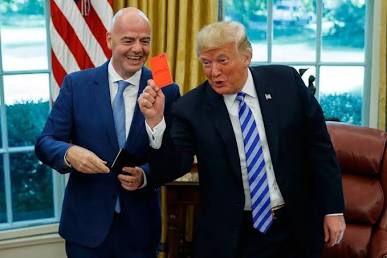
The source of the rule-bending wasn’t hard to find. U.S. President Donald Trump openly admitted to intervening, stating he called FIFA President Gianni Infantino directly to demand a “review” of the star player’s status. While Infantino scrambled to defend FIFA’s decision with a dense, 871-word disciplinary statement claiming total independence, the sports world saw it for what it looked like: a backroom presidential pardon.
Yet, Trump’s heavy-handed intervention ultimately came to nought. On the pitch, Belgium delivered a resounding masterclass, sending a clear message to Washington and Zurich alike: underhanded politics has no place in football.
The Anatomy of a Crisis: Breaking Down the Fallout
The decision triggered an immediate, fierce backlash across Europe. Former Liverpool manager Jurgen Klopp captured the collective fury of the football community, stating: “This is our sport, not theirs. If Donald Trump and Gianni Infantino really sorted this out between themselves, it is madness; it calls everything into question.”
To understand how we arrived at this boiling point, we have to look closely at the mechanics of power currently governing the sport.
1. Why does everyone always say “yes” to Trump?
In global sports diplomacy, money and geography dictate the rules. The U.S. is the financial engine of the 2026 World Cup co-hosting alliance. FIFA is currently desperate to secure American corporate sponsorships and broadcast rights to fund its newly expanded tournaments, including the controversial Club World Cup.
When the leader of the world’s biggest economy—and the literal host of your tournament—asks for a favor, sports executives rarely have the leverage to say no. Infantino and Trump have frequently flaunted their personal friendship, bridging the gap between political muscle and sports governance until the line blurred entirely.
2. What would have happened if Infantino stood his ground?
Had Infantino upheld the rules, he would have preserved the fragile illusion of FIFA’s sporting integrity. FIFA bylaws explicitly forbid government interference in football affairs; in fact, countries like Nigeria and Kuwait have previously been hit with total global bans just because their governments tried to audit local football boards.
By standing his ground, Infantino would have signaled to the world that superpowers are subject to the same disciplinary laws as everyone else. Instead, by capitulating, he has effectively signaled that standard regulations can be negotiated away if you have enough political weight.
3. Could this tip the balance against Infantino after 10 years?
Infantino has officially crossed the decade mark as FIFA president, and he faces a crucial re-election cycle next year. Up until now, his position has felt completely untouchable due to his strong voting blocks in Africa, Asia, and the Americas.
However, this “pardon” might be the definitive breaking point for European governing body UEFA and traditional football powerhouses. Bending the knee to the White House so blatantly compromises the core competitive fairness of the World Cup. If European federations decide to unite and back an alternative candidate, this U.S. red-card controversy may very well be the catalyst that ends the Infantino era.


 By
By