
Exclusive Analysis for ABT NEWS | www.abtnews.net
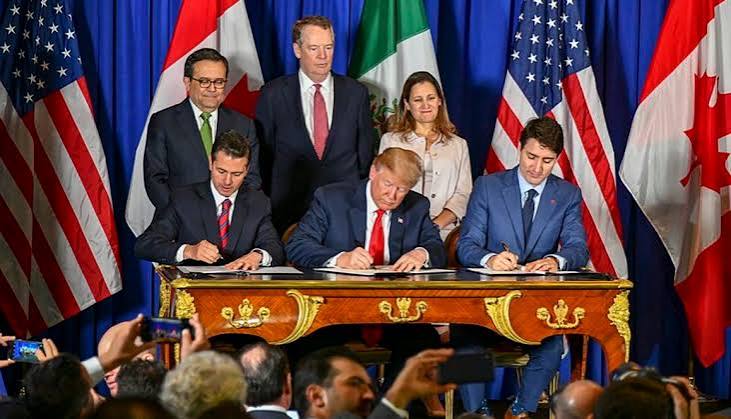
The North American trade landscape has officially entered a period of profound uncertainty. On July 1, 2026, the highly anticipated joint review of the United States-Mexico-Canada Agreement (USMCA) culminated in a pivotal disruption: the United States formally declined to renew the pact in its current form.
While the agreement has not collapsed overnight, the refusal to rubber-stamp a 16-year extension has triggered a high-stakes mechanism, shifting the trillion-dollar trade bloc into a precarious cycle of annual reviews until its potential expiration in 2036.
The Trump Administration’s Playbook
President Donald Trump, who originally championed the USMCA as a signature legislative achievement, opted to keep the agreement on a “short leash” rather than commit to a long-term renewal. The administration’s strategy is clear: use the looming threat of the 2036 expiration as ongoing leverage to extract significant trade concessions.
According to statements from U.S. Trade Representative Jamieson Greer, Washington walked away due to persistent trade deficits and concerns over foreign supply chain dependence. A primary battleground is the automotive sector. In 2024, the U.S. automotive trade deficit with Mexico peaked at $138.2 billion, prompting the administration to push aggressively for stricter Rules of Origin (ROOs). Washington is particularly focused on curbing the integration of Chinese and other Asian components into Mexican automotive exports.
Beyond automobiles, the U.S. is expected to weaponize the annual review process to demand stricter labor enforcement in Mexico—specifically utilizing the Rapid Response Labor Mechanism (RRM)—and to intertwine trade talks with non-trade issues like continental security and migration.
What Options Do Mexico and Canada Have?
Both Ottawa and Mexico City arrived at the July 1 deadline fully prepared to lock in the 16-year extension, only to be rebuffed by Washington. Moving forward, they face a complex geopolitical chessboard with limited but distinct strategic options:
- Strategic Concessions: The most likely path involves absorbing certain U.S. demands to preserve open market access. Mexico has already engaged in a series of bilateral negotiation rounds in Mexico City and Washington to hash out steel, aluminum, and auto manufacturing rules.
- Retaliatory Tariffs: If the U.S. decides to implement aggressive unilateral tariffs, Canada and Mexico possess the economic leverage to retaliate with reciprocal tariffs. However, both nations have historically been placative to maintain stability, knowing a full-scale trade war would severely damage the deeply integrated North American agricultural and manufacturing supply chains.
- Global Diversification: Recognizing the volatility of a U.S.-dependent trade strategy, both nations may accelerate their pivot toward external trade agreements. In Canada, a stagnant domestic economy is already prompting a push to diversify export markets away from the United States over the long term.
What Happens Next?
The sky is not falling immediately. The USMCA remains fully in force today. Preferential tariffs, investment protections, and dispute settlement mechanisms are all still active.
However, businesses reliant on cross-border logistics—particularly in agriculture, electronics, and automotive manufacturing—must now navigate a decade of sustained uncertainty. The Free Trade Commission is mandated to conduct joint reviews every single year moving forward.
The silver lining for global capital markets lies in Article 34.7.4 of the agreement. This “at any time” provision allows the three nations to reinstate a 16-year extension at any point before 2036 without requiring a formal, ground-up renegotiation. Until that consensus is reached, executives and market watchers should expect prolonged negotiations, selective compliance adjustments, and a highly turbulent era for North American trade.



 By
By