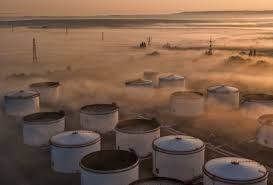

GLOBAL ENERGY DESK — For the past two and a half months, a massive, underappreciated surplus of crude oil—sloshing around in onshore storage tanks and floating aboard supertankers—has shielded the global economy from total disaster following the closure of the Persian Gulf.
But that critical buffer is now vanishing at a record pace.
According to a stark new warning published by The Wall Street Journal, top oil executives and energy analysts are predicting a harsh reckoning within weeks. If the Strait of Hormuz remains blocked amid ongoing geopolitical conflicts, the relative calm in energy markets is set to be violently upended, paving the way for acute fuel shortages and soaring prices worldwide.
The “Illusion of Plenty” When the crisis in the Middle East first choked off one of the world’s most vital energy arteries, the sudden halt in shipments was masked by a drawdown of private storage and government strategic reserves. However, this safety net has left the world with virtually no margin for error.
According to the Paris-based International Energy Agency (IEA), global oil inventories plunged by a staggering 250 million barrels over March and April alone.
A recent report by JPMorgan Chase, aptly titled “The Illusion of Plenty,” estimates that stockpiles in wealthy nations could plunge to “operational stress levels” by early next month. If the blockade persists, the world could hit system-straining “operational floor levels”—known in the industry as tank bottoms—by September.
As Ellen Wald, a senior fellow at the Atlantic Council’s Global Energy Center, bluntly warned: “You can only decrease consumption so much, and when inventories run out, they are going to run out. At some point, the market is going to collide and prices are going to shoot up.”
Diesel Danger and Asia’s Vulnerability The crisis isn’t just about crude; it’s about the refined products that keep the global economy moving.
In the United States, diesel stocks are projected to fall below 100 million barrels by the end of May—the lowest level seen since 2003, according to the consulting firm Eurasia Group. The chief executive of Saudi Aramco has also warned that global stockpiles for gasoline and jet fuel could hit “critically low levels” just ahead of the peak summer travel season.
The situation is even more dire in Asia, a region heavily reliant on Persian Gulf exports. According to estimates by Goldman Sachs, countries like India, Thailand, and Taiwan are rapidly approaching critical scarcity levels for diesel, fuel oil, and naphtha. Several nations have already been forced to impose emergency fuel-saving measures, restrict product exports, and cut refinery runs just to conserve domestic supplies.
The Price of “Demand Destruction” As the physical scramble for oil intensifies, prices are beginning to reflect the shrinking buffer. Global benchmark Brent crude has been trading dynamically, recently pushing past $108 a barrel. But economists at Capital Economics warn that if the Strait remains closed and inventories continue to bleed out, oil prices could violently spike to between $130 and $140 a barrel by next month.
Currently, the only factor keeping the market somewhat balanced is “demand destruction”—the economic phenomenon where prices become so high that consumers and businesses are simply forced to use less. The IEA expects global oil demand to contract sharply this year as a result. However, demand destruction on a large enough scale inevitably translates into a direct and heavy blow to global economic growth.
The message from the energy sector is clear: the world has been living on borrowed time and borrowed oil. Unless the world’s most critical maritime chokepoint reopens soon, the global economy is about to hit empty.
For the latest updates on global energy markets, economic impacts, and breaking geopolitical news, stay tuned to ABT NEWS at www.abtnews.net.


 By
By