
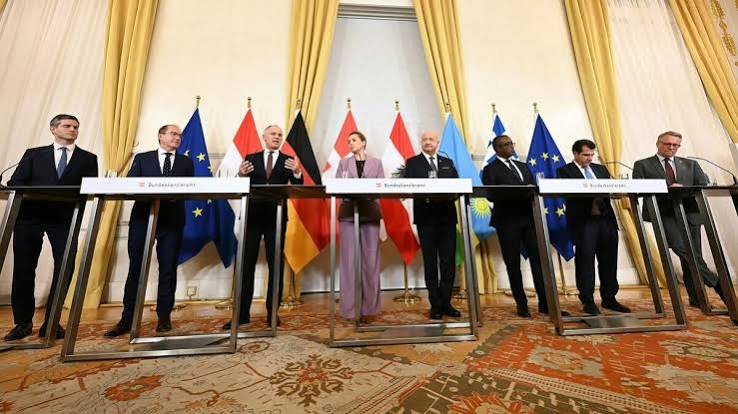

VIENNA — Five European Union member states have announced plans to establish a joint migrant deportation centre in Rwanda, aiming to accelerate removals of rejected asylum seekers and relieve mounting pressure on European immigration systems.
Germany, Denmark, Austria, Greece, and the Netherlands confirmed in official statements on Monday that the facility—referred to as a “return hub”, is scheduled to become operational and begin accepting transfers in 2027.
Unlike the scrapped British asylum scheme, which sought to send migrants to Kigali to have their initial asylum claims processed, the European initiative will apply strictly to individuals staying illegally who have already exhausted all legal avenues to remain in the five nations. The UK’s previous plan was mired in legal challenges and ultimately abandoned by the incoming Labour government in 2024, though Downing Street stated on Monday it would watch the new EU venture “with interest.”
How the Rwanda “Return Hub” Will Work
The agreement follows a recent EU legislative reform permitting the creation of deportation hubs outside the bloc’s borders. According to the Dutch government, the facility will serve as an alternative destination when deportees cannot be returned directly to their countries of origin.
Key details of the pilot phase include:
- Initial Capacity: Diplomatic sources told ABT NEWS the hub will launch as a pilot project hosting roughly 100 people, with each of the five participating nations expected to transfer around 20 migrants.
- Target Demographic: The first phase will apply exclusively to single men, with the Netherlands specifying its focus will be on nationals from countries in the same geographical region as Rwanda. Unaccompanied children will not be transferred to the facility.
- Life in Rwanda: Once transferred, individuals can either choose to return to their home countries or integrate into Rwandan society, which includes the right of residence alongside access to the labour market, healthcare, education, and the legal system.
European and Rwandan Officials Defend the Deal
Speaking at a joint press conference in Vienna on Monday, Austrian Chancellor Christian Stocker said the coalition aims to ease the strain on European asylum infrastructure and disrupt human trafficking networks orchestrating dangerous Mediterranean crossings.
Rwandan Interior Minister Vincent Biruta echoed the commitment to partnership, stating Kigali is dedicated to providing a “safe, legal and dignified solution for migrants” while working to address the “global imbalance in economic opportunities” driving irregular migration.
The United Nations’ International Organisation for Migration (IOM) may also take on an ancillary role. An IOM spokesperson confirmed the agency is in discussions with several EU nations regarding return hubs, noting its extensive experience assisting migrants in complex transit situations.
Human Rights Backlash and Political Context
While the five governments insist the scheme complies with EU and international law, human rights advocates have raised sharp objections.
Clementine de Montjoye, senior Africa researcher at Human Rights Watch, warned that Rwanda’s track record makes it an unsuitable partner, citing “repression of dissent, arbitrary detention, ill-treatment in detention,” and Kigali’s backing of armed rebels in the neighbouring Democratic Republic of Congo.
“Paying Kigali to host a deportation programme would not only cause suffering and harm to those deported, it would finance and provide political leverage to a government responsible for serious human rights abuses at home and abroad.”
— Clementine de Montjoye, Human Rights Watch
The independent EU Agency for Fundamental Rights similarly stressed that any third-country host must uphold fundamental protections and ensure deportees are not placed at serious risk of persecution.
Migration Trends Across the Bloc
The announcement comes as governing parties across Europe face intense voter frustration over struggling economies, security concerns, and border control ahead of several national elections.
Data from the European Border and Coast Guard Agency (Frontex) shows irregular border crossings into the EU dropped by 29% in the first 10 months of 2026 compared to the previous year, totalling nearly 110,000 detections. However, monthly figures ticked upward in October to roughly 18,100 crossings, a 22% jump from September, driven largely by a surge in arrivals along the Western African route to Spain’s Canary Islands.



 By