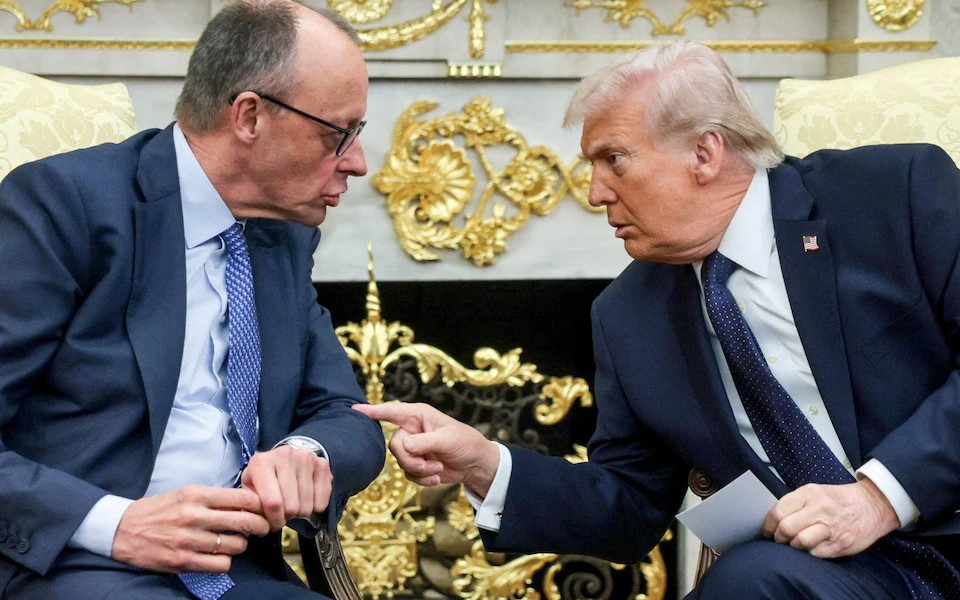

BERLIN/WASHINGTON — The long-standing alliance between the United States and Germany is facing its most severe stress test in decades as a public war of words between President Donald Trump and German Chancellor Friedrich Merz escalates into a full-blown diplomatic and economic crisis.
The spat, which began with differing views on foreign policy, has rapidly deteriorated into threats of troop withdrawals and a massive 25% tariff hike on European automobiles.
WHAT HAPPENED: FROM CRITICISM TO CONFRONTATION
The firestorm was ignited earlier this week when Chancellor Merz, speaking to students in the German town of Marsberg, issued an uncharacteristically blunt critique of U.S. foreign policy. Merz claimed that the United States was being “humiliated” by the Iranian leadership during ongoing negotiations to end the two-month-old U.S.-Israeli conflict with Iran.
Merz argued that the Trump administration lacked a “convincing exit strategy” and noted that the war was “costing us [Germany] a great deal of money,” particularly due to the disruption of energy supplies through the partially mined Strait of Hormuz.
President Trump’s response was swift and stinging. Taking to Truth Social, the President slammed Merz as being “totally ineffective” and accused him of failing to end the Russia-Ukraine war or fix Germany’s “broken” immigration and energy policies.
“The Chancellor of Germany should spend more time on ending the war with Russia/Ukraine… and less time on interfering with those that are getting rid of the Iran Nuclear threat,” Trump posted, adding that Merz “doesn’t know what he’s talking about.”
The situation took a darker turn on Thursday when Trump suggested he is reviewing a reduction of the 36,000+ U.S. troops stationed in Germany, a foundational pillar of European security since World War II.
THE IMPLICATIONS: A HIGH-STAKES GAMBLE
The fallout from this personal rivalry is no longer confined to social media; it is now dictating international trade and security policy.
For Germany: An Economic and Security Nightmare
- Industrial Disaster: As the largest exporter of cars to the U.S. within the EU, Germany is the primary target of Trump’s new 25% car tariffs. With companies like Porsche and Audi facing astronomical costs, the German automotive backbone is bracing for a recession.
- Security Vacuum: The threat of U.S. troop withdrawals leaves Germany vulnerable. While Merz has doubled down on “European sovereignty,” Germany’s military is currently not equipped to replace the logistical and strategic shield provided by U.S. bases like Ramstein.
- Energy Insecurity: Merz’s anxiety over Iran is rooted in reality. Germany is suffering from soaring energy prices as the war in the Middle East chokes global supply.
For the United States: Strategic Isolation?
- NATO Fragility: By publicly feuding with the leader of Europe’s largest economy, Trump risks alienating key NATO allies at a time when the U.S. is already stretched across multiple fronts (Ukraine and Iran).
- Consumer Costs: While Trump aims to force automakers to move plants to the U.S., the immediate effect of 25% tariffs will likely be higher prices for American car buyers and potential retaliatory tariffs on U.S. agricultural exports to Europe.
- Leverage in Iran: Merz’s comments suggest that European support for U.S. actions in Iran is evaporating. Without a united Western front, the U.S. may find it harder to secure a lasting diplomatic victory against Tehran.
THE BOTTOM LINE
While Chancellor Merz has attempted to de-escalate, telling reporters on Wednesday that his personal relationship with Trump remains “good,” the President’s subsequent tariff announcement suggests the “Turnberry Agreement” is dead.
For ABT NEWS, this remains a developing story. As the 25% tariff deadline approaches next week, the world waits to see if this is a masterclass in “Art of the Deal” brinkmanship or the permanent fracturing of the West.
For more updates on the Transatlantic Trade War, visit www.abtnews.net.


 By
By