
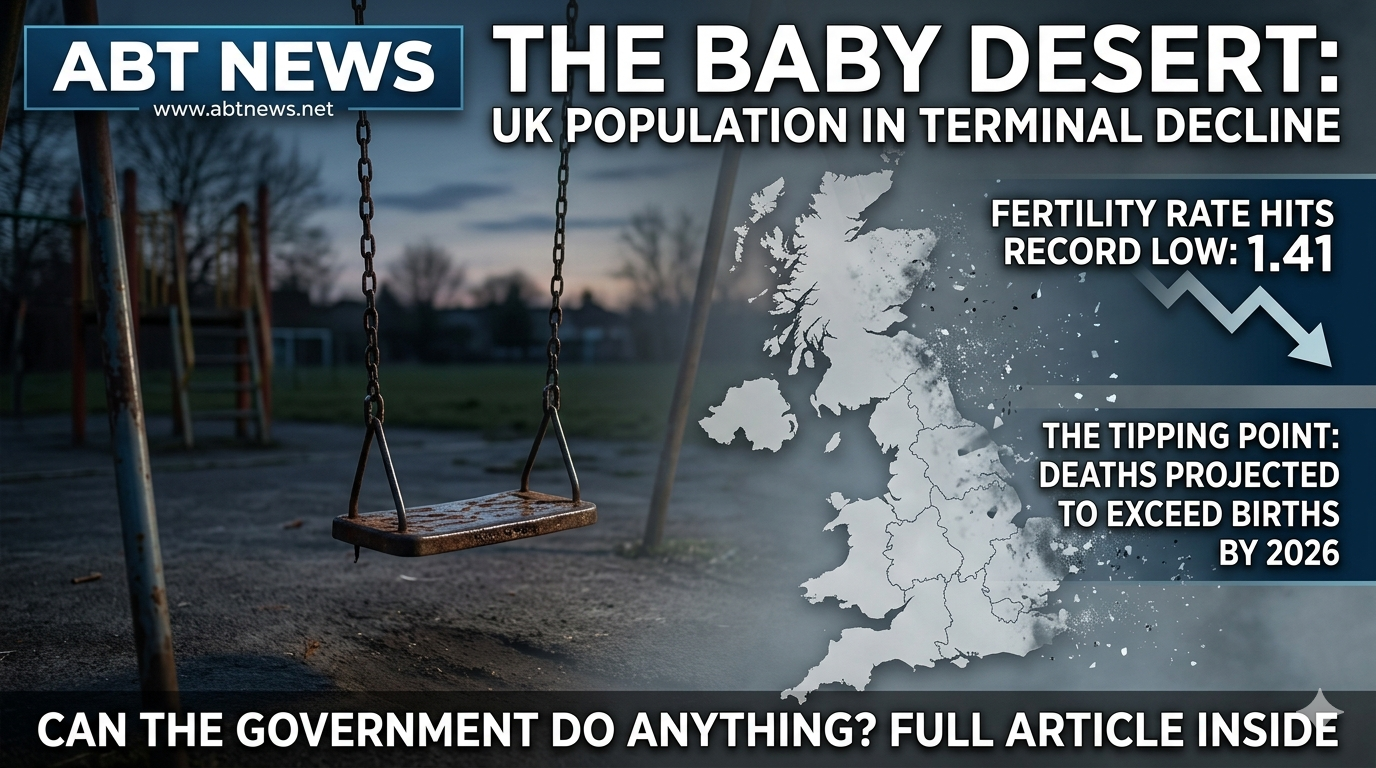

LONDON — Something is fundamentally breaking in the social fabric of the United Kingdom. New data from the Office for National Statistics (ONS) has sent shockwaves through Westminster, revealing that the birth rate in England and Wales has plummeted to its lowest level since records began in 1938.
The United Kingdom is officially entering a “Baby Desert,” and the implications for the future of the British economy, the NHS, and the national identity are nothing short of terrifying.
The Numbers of a Sinking Ship
The latest figures are stark. The Total Fertility Rate (TFR)—the average number of children a woman has in her lifetime—has dropped to just 1.41.
To put that in perspective, a country needs a rate of 2.1 to maintain a stable population without relying on immigration. The UK hasn’t hit that “replacement level” since the 1970s, but the current freefall is unprecedented. In 2024, there were roughly 594,000 live births, a figure that continues to hover near historic lows, while the average age of first-time parents continues to climb to record highs (31.0 for mothers and 33.9 for fathers).
The “Tipping Point”: 2026
We are fast approaching what demographers call the “Death Cross.” By 2026, the number of deaths in the UK is projected to exceed the number of births for the first time in peacetime history.
From that point on, the only thing keeping the UK population from shrinking is net migration. Currently, the ONS projects the UK population will hit 70 million by 2027, but this growth is entirely “imported.” Without the arrival of hundreds of thousands of people from overseas every year, the UK would already be in a state of terminal decline.
What Does the Future Hold?
If the current trend continues, the UK faces a “Silver Tsunami” that will bankrupt the state.
- A Shrinking Workforce: Fewer babies today means fewer taxpayers tomorrow. With a smaller pool of workers to fund the pensions and healthcare of a massive elderly population, the tax burden on the young will become unbearable.
- The NHS Collapse: An aging population requires more care, but there will be fewer young people to work as doctors, nurses, and carers.
- Economic Stagnation: Societies with low birth rates tend to lose their innovative edge. Economic growth stalls as domestic markets shrink and businesses struggle to find staff.
Why are Brits Stopping?
It isn’t that people don’t want children; it’s that they can no longer afford them.
- The Childcare Trap: The UK has some of the most expensive childcare in the developed world. Many mothers are effectively “pushed out” of the workforce because their entire salary would go toward nursery fees.
- The Housing Crisis: Young couples are stuck in cramped rentals or living with parents well into their 30s. Without a stable “nest,” the idea of starting a family feels like a financial suicide mission.
- Maternal Care in Danger: Shortages in midwifery and postnatal care have left many women terrified of the birthing process itself.
Can the Government Do Anything?
The “Pro-Natalist” debate is now center-stage in British politics, but the solutions are expensive and politically difficult.
1. Radical Childcare Reform: The government has begun expanding “free hours,” but critics say the funding doesn’t cover the actual costs, leading to nursery closures. A “full-fat” state-funded childcare system, similar to those in Scandinavia, is being debated but would require massive tax hikes.
2. Tax Incentives: Some MPs are calling for “Family Tax Splitting,” where a household is taxed as a unit rather than as individuals, significantly lowering the burden on single-income families with stay-at-home parents.
3. Direct Subsidies: Countries like Hungary and South Korea have tried “baby bonuses” and low-interest loans for parents, but so far, these have failed to move the needle significantly.
4. Fixing Housing: Unless the government builds millions of homes to drive down prices, the demographic trend is unlikely to reverse.
The Bottom Line
The UK is currently a country that is growing older, but not younger. We are trading long-term domestic stability for short-term migration fixes. Unless the government makes “having a family” a viable economic choice again, the British “stork” may never return.
The clock is ticking. Are we witnessing the slow-motion sunset of Great Britain?
For more deep dives into the issues affecting your world, visit www.abtnews.net.


 By
By