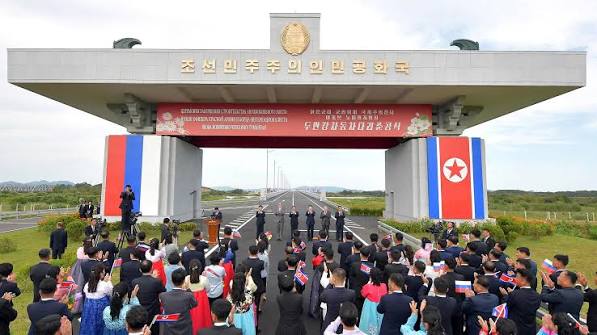

PYONGYANG / MOSCOW — Russia and North Korea have officially opened their first dedicated road bridge across the Tumen River, establishing a direct physical link between the border cities of Khasan in Russia and Rason in North Korea.
The two-lane, one-kilometer structure—officially named the Yakov Novichenko Bridge after a Soviet officer credited with saving Kim Il Sung from an assassination attempt in 1946, was inaugurated in a virtual ceremony led by Russian Prime Minister Mikhail Mishustin and North Korean Premier Pak Thae Song.
========================================================================================
                               BRIDGE SPECIFICATIONS
========================================================================================
• Location:    Tumen River (Connecting Khasan, Russia to Rason, North Korea)
• Length / Width:  1.005 km (0.6 miles) | 2 traffic lanes (7 meters wide)
• Estimated Capacity: Up to 300 vehicles and 2,323 passengers per day
• Construction Cost:  ~9 billion rubles ($104 million)
• Primary Operations: Cargo transit (active immediately); Passenger traffic (late 2026)
========================================================================================
Stated Purpose vs. Military Logistics
According to official state media from both capitals, the bridge is designed to boost cross-border commercial trade, tourism, and personnel exchanges, connecting North Korea directly into Russia’s federal highway network heading toward Vladivostok. Russian Prime Minister Mishustin praised the structure as a “new symbol of friendship” and a catalyst for deeper economic and technical cooperation.
However, Western intelligence analysts, South Korean authorities, and military research groups highlight a critical secondary function: covert military logistics.
Prior to the bridge’s opening, overland transit between the two nations was limited to an aging 1950s railway bridge, where road vehicles could cross only via makeshift wooden planks laid across train tracks. The new two-lane road bridge eliminates cargo transfer bottlenecks, allowing direct vehicular transport for military hardware, munitions, and personnel.
Strategic Appraisal: What This Means for the World and the West
The opening of the Tumen River road bridge is not merely an infrastructure upgrade; it represents a tangible consolidation of the Moscow-Pyongyang strategic axis.
1. Evasion of Western Sanctions and Monitoring
Vehicular road transport presents a significantly harder target for satellite reconnaissance and Western intelligence monitoring compared to maritime shipping or rigid rail corridors.
- Hidden Shipments: Sealed cargo trucks can easily disguise military payloads or dual-use technologies, making it significantly harder to trace UN Security Council sanction violations.
- Streamlined Logistics: Unlike rail networks that require wheel-gauge adjustments at border transfer points, truck convoys can move continuously from North Korean industrial/military zones directly to Russian logistics hubs.
2. Sustaining Russia’s War Capacity in Ukraine
North Korea has already supplied billions of dollars worth of artillery shells, rockets, and ballistic missiles to Russia, alongside thousands of deployed troops.
- The new road link guarantees a secondary, weather-resistant supply route to complement rail lines, accelerating the flow of conventional arms to front-line Russian units in Europe.
3. Mutual Reinforcement of Rogue States
The physical bridge anchors the Comprehensive Strategic Partnership Agreement signed by Vladimir Putin and Kim Jong Un.
- Quid Pro Quo Risk: In exchange for artillery and personnel, Russia is increasingly positioned to provide North Korea with advanced military technology (e.g., satellite guidance, submarine warfare tech, air defense) as well as critical oil and food supplies.
- Reduced Western Leverage: Economic sanctions lose effectiveness when rogue nations build isolated, self-sustaining trade corridors outside the international financial system.
4. Strategic Strain on the West and NATO Allies
For Western powers—specifically the United States, NATO, South Korea, and Japan—this infrastructure links two distinct security theaters:
- Two-Front Friction: Western defense strategies must now account for a seamless military pipeline where East Asian security crises directly fuel Eastern European warfare, complicating defense allocation and deterrence strategy in both the Euro-Atlantic and Indo-Pacific regions.


 By
By