
Lagos, Nigeria — There is a particular kind of delusion that money buys in Nigeria today. It does not buy freedom. It certainly does not buy security. And it is nowhere near the neighborhood of progress.
Instead, as a devastating new sociological reality takes hold across the nation, wealth simply buys a more expensive version of the exact same suffering.
This grim reality is the quiet engine accelerating Nigeria’s unprecedented brain drain, colloquially known as the “Japa” wave. For years, the narrative surrounding the mass exodus of Nigeria’s doctors, engineers, tech innovators, and academics has centered on the search for better pay. But a closer look reveals a darker, more damning truth: the middle and upper classes are fleeing because they have finally realized that no amount of money can insulate them from a system that is actively rotting.
The Illusion of Private Infrastructure
For decades, successful Nigerians have attempted to build private utopias to survive public failures. They dress up their systemic suffering in imported solar panels, Starlink satellite dishes, and towering estate gates. But these are merely temporary delays of the inevitable.
The irony of Nigerian success is that every solution purchased creates a new, unbudgeted problem. You buy a rugged SUV to survive the cratered, unpaved roads, only to instantly become a high-value kidnapping target. You move into a heavily guarded, gated estate, only to discover that your safety abruptly ends the second your tires roll past the security boom.
You spend millions installing a state-of-the-art solar grid to escape the national power grid’s collapse, yet you spend your nights listening to the deafening roar of your neighbor’s diesel generator. You subscribe to Starlink to bypass failing local telecom networks, and suddenly your entire compound expects to piggyback on your connection. You finally make money, and instantly become a magnet for a dozen people desperately running from the exact same poverty you just escaped.
The Tragedy of Maladaptation
Sociologists call this phenomenon “maladaptation.” It is the quiet, expensive habit of building personal workarounds inside a system that is in a state of terminal decay. Instead of fixing the foundation, the Nigerian elite are busy decorating the penthouse of a collapsing building.
The most dangerous consequence of this maladaptation is the psychology it produces. In Nigeria, the benchmark for a good life is no longer whether the country actually works. The benchmark is simply whether you are doing better than the person suffering next to you.
That stark contrast—your roaring generator versus their suffocating darkness, your private estate versus their dangerous open street—has become the tragic definition of Nigerian success.
Why Nobody Protests—And Why Everyone Leaves
This localized, hyper-individualistic survival mechanism explains a glaring mystery: why a nation enduring such profound institutional failure sees so little systemic pushback.
Nobody protests. Nobody organizes. Nobody demands better roads, reliable power, or functional hospitals. Why? Because the very people with the resources, education, and influence to demand structural change are too busy funding their own private escapes. They have replaced the government in their own lives, acting as their own ministries of power, water, security, and works.
But the private workarounds are failing.
The rot has no ceiling, and it is aggressively creeping toward the gates of the privileged. Inflation is eroding the purchasing power required to maintain these private micro-states. Insecurity has metastasized to the point that even the highest walls and the thickest bulletproof glass offer no real guarantee of tomorrow.
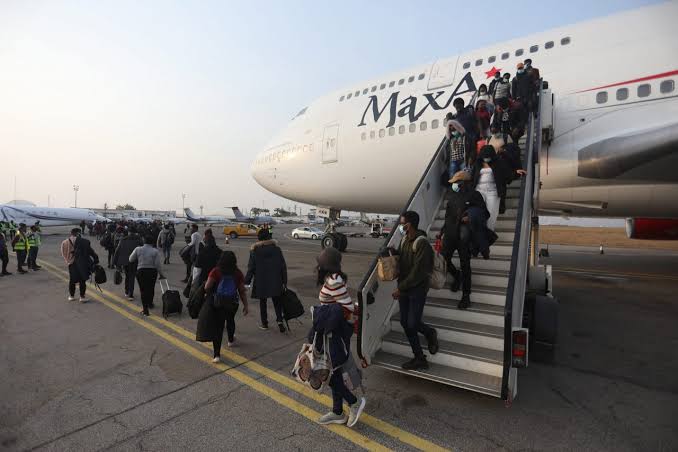
This is what is truly fueling the brain drain. The mass migration to the UK, Canada, the US, and Australia is not merely a pursuit of foreign currencies; it is the ultimate realization that the local workaround has reached its limit. When the private estate fails, the only gate left to hide behind is an international departure terminal.
The question for those who remain in Nigeria is no longer whether they can afford the workaround. The question is how long before the workaround stops working entirely.
For more in-depth analysis on Nigeria’s socio-economic landscape and the ongoing migration crisis, stay tuned to ABT NEWS at www.abtnews.net.
It pays to advertise your business, products and services on ABT NEWS www.abtnews.net. Please send your enquiries to advertise@abtnews.net or +447918790290

 By
By