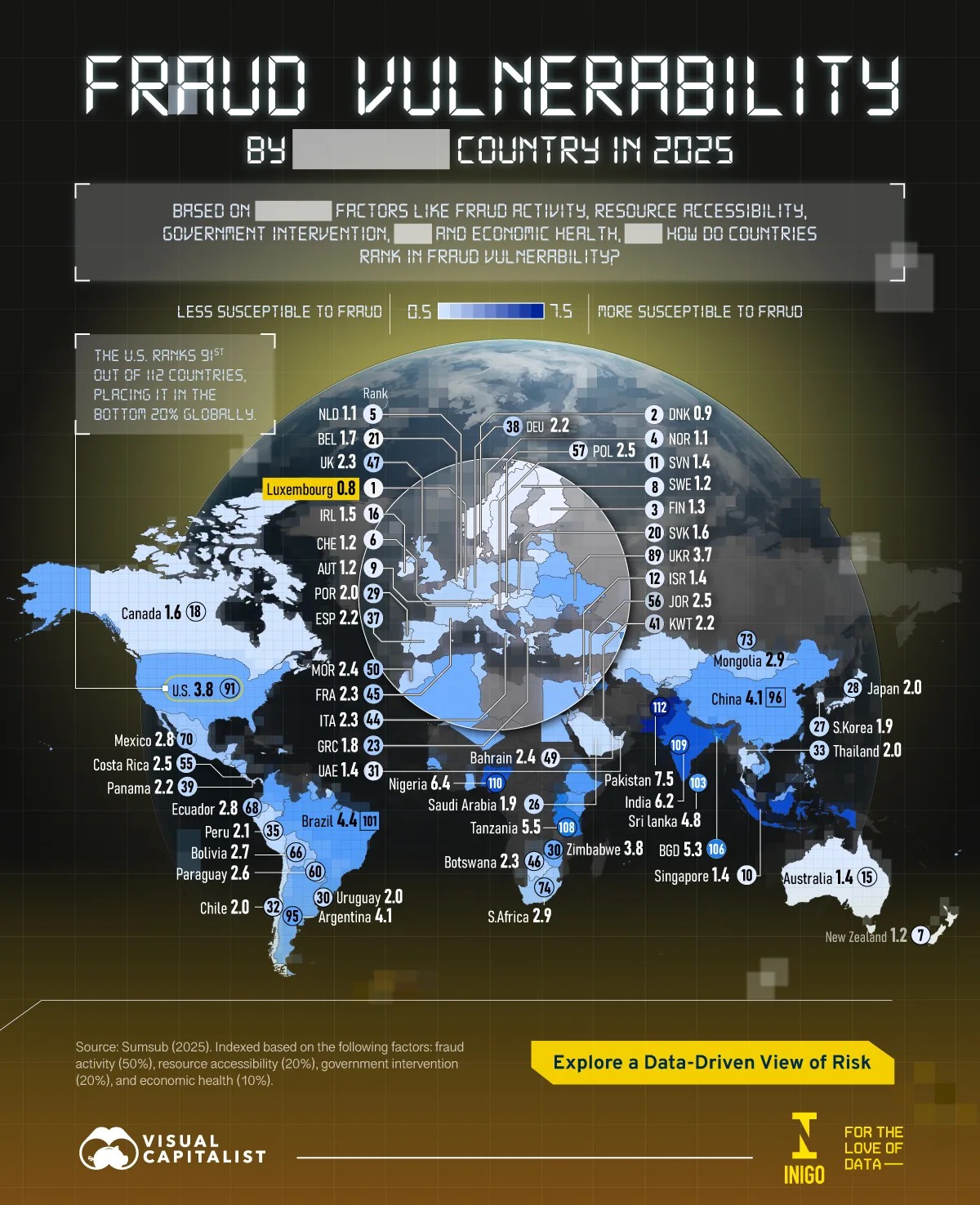

As we navigate the mid-point of 2026, the digital landscape has become a double-edged sword. While technology connects us more than ever, it has also opened the floodgates for increasingly sophisticated fraud. A comprehensive new data report from Sumsub, featured on Visual Capitalist, has mapped out the global “Fraud Vulnerability Index,” and the results are a wake-up call for several major world powers.
Using a weighted index that accounts for fraud activity (50%), resource accessibility (20%), government intervention (20%), and economic health (10%), the study ranks 112 countries on their resilience against scams.
The Gold Standard: Where the Scammers Fail
If you’re looking for a digital fortress, look toward Europe. According to the data, Luxembourg takes the crown as the least vulnerable country in the world with a score of 0.8. Close behind are:
- Denmark: 0.9 (Ranked 2nd)
- Finland: 1.3 (Ranked 3rd)
- Netherlands: 1.1 (Ranked 5th)
These nations benefit from high economic stability and aggressive government intervention, making them difficult targets for bad actors. Outside of Europe, New Zealand (Ranked 7th) and Singapore (Ranked 10th) remain global leaders in fraud prevention.
The “American Surprise”: A Vulnerability Gap
Perhaps the most jarring statistic is the standing of the United States. Despite its technological prowess, the U.S. ranks 91st out of 112 countries, placing it firmly in the bottom 20% globally.
With a vulnerability score of 3.8, the U.S. faces significant challenges due to high levels of fraud activity and the sheer volume of accessible digital resources that attackers can exploit. This ranking serves as a stark reminder that a high GDP does not necessarily equal high digital security.
High-Risk Zones: The 2025 Danger Map
On the opposite end of the spectrum, several countries are struggling with extreme susceptibility. These regions often face a “perfect storm” of limited government resources and high volumes of illicit activity:
| Country | Vulnerability Score | Global Rank |
| Pakistan | 7.5 | 112 |
| Nigeria | 6.4 | 110 |
| India | 6.2 | 103 |
| Brazil | 4.4 | 101 |
What’s Driving the Risk?
To understand why these scores vary so wildly, we have to look at the “Risk Pillars.” Fraud vulnerability isn’t just about how many scammers live in a country; it’s about how easily they can access tools and how hard the government fights back.
- Fraud Activity: The sheer volume of detected scams.
- Resource Accessibility: How easy it is for scammers to find “targets” (emails, phone numbers, data leaks).
- Government Intervention: The strength of local cyber-laws and police task forces.
- Economic Health: Often, economic instability can drive individuals toward cybercrime as a means of survival.
The Bottom Line
As the data suggests, fraud is no longer a localized issue—it is a global epidemic that requires more than just individual vigilance. For citizens in the “Bottom 20%,” including the U.S. and India, the message is clear: the digital walls need to be re-built higher, and they need to be re-enforced fast.
For more in-depth analysis on global risk trends, please stay glued to www.abtnews.net


 By
By