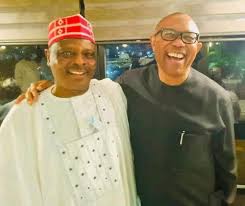

The political chessboard for Nigeria’s 2027 general elections has witnessed a massive disruption. In what many analysts are describing as a masterstroke of opposition alignment, former Labour Party presidential candidate Peter Obi and former Kano State Governor Rabiu Kwankwaso have officially defected to the Nigeria Democratic Congress (NDC).
Leaving behind the internal turbulence of the African Democratic Congress (ADC), the two political heavyweights have merged their formidable grassroots machines—the “Obidient” movement and the “Kwankwasiyya” massive follower base—into a new mega-platform. The arrival of the duo at the NDC national secretariat in Abuja, where they were warmly received by NDC National Leader, Senator Seriake Dickson, and National Chairman, Moses Cleopas, signals the birth of a unified front aiming to unseat the ruling establishment.
What Should Nigerians Expect from This Development?
The emergence of the “OK Movement” (Obi-Kwankwaso) under the NDC umbrella promises a radical departure from the fractured opposition of the past. For millions of Nigerians battling the harsh realities of economic hardship, inflation, and insecurity, this alliance is being heavily touted as a rescue mission.
1. A Formidable Joint Ticket: Political analysts are already forecasting that an Obi-Kwankwaso presidential and vice-presidential ticket would be incredibly difficult for the ruling party to beat. By bridging the massive voting bloc of the populous North (driven by Kwankwaso) with the widespread youth and Southern/Middle-Belt support (driven by Obi), the NDC is instantly positioned as a national powerhouse.
2. Focus on Youth, Economy, and Education: During their declaration, Peter Obi wasted no time addressing the core issues, stating emphatically that it is unacceptable for more than 50% of Nigeria’s population to remain economically unproductive. Nigerians can expect the NDC to campaign heavily on wealth creation, tackling multidimensional poverty, and restoring security. Kwankwaso, known for his vast educational reforms in Kano, echoed these sentiments, promising that the new platform will prioritize education, youth, and women empowerment.
3. An End to Internal Party Crises: Both leaders made it clear that the NDC represents a clean break from the endless litigations and infighting that have plagued traditional opposition parties like the PDP and Labour Party. They are building an ideological platform focused solely on national development rather than petty political squabbles.
How Does the Political Establishment View the NDC?
The political establishment, particularly the ruling All Progressives Congress (APC), is watching this development with intense scrutiny, even as they attempt to publicly downplay its significance.
Publicly, figures within the Presidency and the APC—including Bayo Onanuga and party spokesperson Felix Morka—have been quick to dismiss the move. They have criticized Obi and Kwankwaso for their repeated party defections, attempting to frame the new coalition as a gathering of desperate politicians lacking ideological grounding. A resurfaced video of Obi previously speaking against party-hopping has already been weaponized by ruling party loyalists to dampen the momentum.
However, behind closed doors, the establishment recognizes the sheer existential threat the NDC now poses. The ruling party benefited immensely from a divided opposition in the last election. With millions of highly mobilized young Nigerians, diaspora backers, and northern grassroots voters now converging under a single NDC banner, the APC’s path to re-election in 2027 has become significantly more complicated.
The Bottom Line
The Nigerian political landscape is undeniably shifting. The NDC has morphed overnight from an alternative option into a dominant mega-party. For the millions of citizens rushing to register for NDC membership cards across the 36 states, this is more than just a political realignment—it is the rekindling of hope.
As the countdown to 2027 begins, all eyes are on the NDC. Whether the establishment likes it or not, the “OK Movement” has drawn the battle lines, and the race to rescue Nigeria has officially kicked off.
For continuous updates on Nigeria’s political landscape and the road to 2027, keep it locked on ABT NEWS at www.abtnews.net

 By
By