
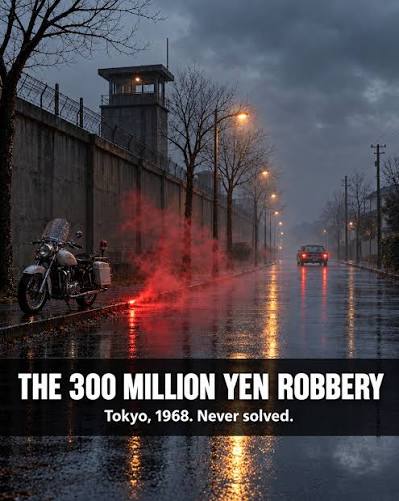

On a rainy morning in December 1968, a lone man in a crisp police uniform pulled off the single largest cash heist in Japanese history. In less than three minutes, without drawing a weapon or harming a single soul, he walked away with nearly 300 million yen—and vanished into thin air.
More than half a century later, the 300 Million Yen Robbery (San-oku-en jiken) remains Japan’s most baffling unsolved mystery, a masterclass in psychological manipulation, timing, and sheer audacity.
The Setup: A Psychological Trap
The heist was not a spur-of-the-moment ambush; it was a carefully rehearsed psychological trap.
On December 6, 1968—just four days before the robbery—the manager of the Kokubunji branch of the Nihon Shintaku Ginko (Nippon Trust Bank) received an anonymous threatening letter. The note demanded 3 million yen and warned that if the bank failed to comply, the branch manager’s home would be blown up.
Police staked out the designated drop-off point with dozens of officers, but no one ever showed up. While authorities began to suspect a hoax, the threat achieved its true purpose: it put every employee at the bank on high alert for explosives.
Three Minutes of Pure Deception
At 9:30 a.m. on December 10, 1968, four bank employees set out from the Kokubunji branch in an unmarked, company-owned black Nissan Cedric sedan. Stashed in the trunk were three duralumin metal boxes containing ¥294,307,500 in cash—roughly $817,500 at the time, or well over $8 million adjusted for modern inflation. The money was destined for the nearby Toshiba factory in Fuchu to pay out employees’ year-end bonuses.
Just 200 meters from the factory gates, on a quiet stretch of road beside Fuchu Prison, a young man riding a white motorcycle signaled the sedan to pull over.
Dressed in the unmistakable uniform of a Tokyo Metropolitan Police motorcycle officer, he calmly approached the driver’s window. Playing directly into the bank staff’s existing fears, he delivered a chilling warning: the branch manager’s house had just been bombed, and police had received a tip that dynamite had been planted in their transport car.
The four employees immediately exited the vehicle. The “officer” dropped to the pavement and crawled beneath the sedan to inspect the undercarriage. Seconds later, smoke and bright orange flames erupted from beneath the chassis.
“It’s going to blow! Run!” the officer shouted, scrambling out from under the car.
Terrified of an imminent explosion, the four employees sprinted away for cover. Watching the uniformed officer climb into the driver’s seat and speed off, the bank workers initially believed they were witnessing a heroic act—a brave policeman risking his life to drive a ticking time bomb away from bystanders.
In reality, there was no bomb. The thief had simply ignited a standard highway road flare under the car to create the illusion of a fusing explosive.
A Trail of Red Herrings and Getaway Cars
By the time the bank employees realized they had been duped, the thief was long gone. Investigators soon uncovered the sheer scale of the culprit’s preparation:
- A Chain of Stolen Vehicles: The thief abandoned the Nissan Cedric roughly 1.5 kilometers from the scene, transferring the heavy metal cash boxes into a pre-staged stolen car, and later swapping vehicles again to erase his trail.
- A Mountain of Decoy Evidence: Police recovered over 120 pieces of physical evidence at the scene, including the “police” motorcycle—which turned out to be a stolen Yamaha painted white—along with a hunting hat, a megaphone, and the spent road flare. Rather than careless mistakes, investigators realized the culprit had intentionally scattered mass-produced, untraceable items to bog down forensics.
The Largest Manhunt in Japanese History
What followed was an unprecedented—and ultimately futile—investigation. Over the next seven years, the Tokyo Metropolitan Police mobilized 170,000 officers, screened 110,000 suspects, compared six million fingerprints, and distributed 780,000 composite sketches across the nation.
The search cost taxpayers roughly 900 million yen—more than three times the amount stolen—and was marred by tragedy and missteps. Just five days after the heist, a 19-year-old suspect (the son of a police officer) died by suicide via potassium cyanide poisoning, though no money was ever linked to him. A year later, police falsely arrested a 26-year-old man who resembled the composite sketch, only to discover he had an airtight alibi: he was taking a proctored exam at the exact moment of the robbery.
The Case Goes Cold
On December 10, 1975, the seven-year criminal statute of limitations expired. Under Japanese law, the mastermind could no longer be prosecuted. In 1988, the civil statute of limitations also ran out, meaning the thief could theoretically walk onto live television, confess to every detail, and legally keep the fortune.
Yet, no one ever came forward. Even more remarkably, of the 2,000 banknotes whose serial numbers had been recorded by the bank, not a single bill ever surfaced in circulation. (Because the cash was insured, Toshiba’s employees still received their year-end bonuses on time.)
Decades later, the 300 Million Yen Robbery stands alone in true-crime history—not as a tale of brute force, but as a testament to how a sharp disguise, a flare, and a deep understanding of human psychology defeated an entire nation’s police force.



 By