
ABT NEWS www.abtnews.net | WORLD NEWS | LATIN AMERICA
SÃO PAULO — In a historic and fiercely contested runoff election, Brazil’s President Luiz Inácio Lula da Silva has secured a fourth term in office, completing a dramatic comeback over his right-wing challenger, Senator Flávio Bolsonaro.
The 80-year-old left-wing leader clinched 51.79% of the valid votes against Bolsonaro’s 48.21%—a margin of approximately 4.4 million votes. The victory marks a monumental moment in modern Brazilian political history, making Lula the first president since the restoration of civilian democracy in 1985 to win the presidency after trailing in the first round of voting.
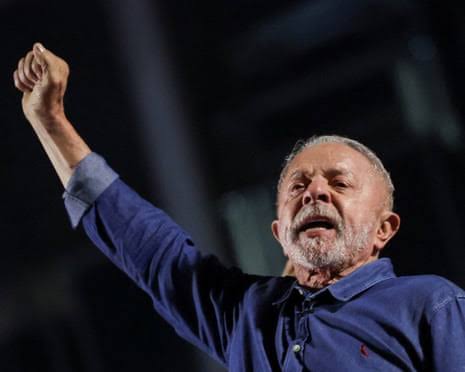
Addressing jubilant crowds gathered on the streets of São Paulo, Lula declared the result a victory for democratic norms and national unity.
“This was a loss for negativity, lies,” Lula told his cheering supporters. “This, my fourth term, will be the best of any president in the history of this country. It will be the one in which I listen most to the Brazilian people.”
Vice-President Geraldo Alckmin echoed the historic weight of the moment, telling Lula: “You, for the second time, have saved Brazilian democracy.”
A First-Round Deficit Turnaround
The runoff result delivered a major upset following the first round of voting on October 4, where Flávio Bolsonaro, backed by his father, convicted former president Jair Bolsonaro, led the field with 47% of the vote over Lula’s 45%.
However, Lula’s campaign built decisive momentum in the final weeks by mounting a massive mobilization drive. Focusing heavily on voter turnout after 33 million citizens abstained in round one, Sunday saw the largest drop in abstention between first and second rounds in a Brazilian presidential contest since 1989.
| Candidate | First Round (Oct 4) | Runoff Result | Total Margin |
| Luiz Inácio Lula da Silva (PT) | 45.0% | 51.79% | + 4.4 million votes |
| Flávio Bolsonaro (PL) | 47.0% | 48.21% | — |
Unprecedented Voting Extension and Legal Challenges
Election day was marked by high tension and unprecedented legal maneuvers. In an extraordinary move, polling hours were extended by two hours on Sunday evening following separate petitions from both campaign camps:
- Lula’s Campaign: Cited severe transportation shortages in São Paulo and Bahia that left voters unable to reach polling stations.
- Bolsonaro’s Campaign: Pointed to torrential rainfall in southern regions and parts of São Paulo that hampered voter access.
The directive, issued by the Supreme Court just as polls were scheduled to close, caused operational confusion, as some polling stations had already shut down and were unable to reopen. Despite these logistics, Supreme Court President Kassio Nunes Marques confirmed Lula’s victory, stating that the extension did not compromise the count or the integrity of the electoral process.
Flávio Bolsonaro has so far refused to concede, calling the results “inexplicable” and demanding an annulment during a press conference.
However, legal experts overwhelmingly downplay the likelihood of any challenge succeeding. Fernando Neisser from the Institute of Lawyers of São Paulo (IASP) noted that an annulment is “difficult from a legal standpoint” given the clear vote gap. Legal analyst Alberto Rollo added that fixed constitutional dates for presidential elections present further barriers to overturning the outcome.
Global Reactions & Geopolitical Strains
Lula’s reelection bucked a recent regional trend across Latin America, where voters in nations such as Argentina, Chile, and Colombia have leaned toward right-wing leadership.
His upcoming term, set to begin on January 5, will present formidable governance challenges, including a deeply polarized populace, a hostile conservative-led Congress, and complex international dynamics. During his speech, Lula directly referenced US foreign policy under President Donald Trump and his “Donroe Doctrine” framework.
“Either the homeland remains free, or we die for Brazil,” Lula affirmed. “This country will not accept being anyone’s backyard.”
While Washington has yet to officially react, congratulations poured in from political leaders across the globe:
- European Union: European Commission President Ursula von der Leyen stated that “democracy and multilateralism” had prevailed.
- France: President Emmanuel Macron called for joint action “in service of a more just world.”
- Spain: Prime Minister Pedro Sánchez celebrated a “great victory,” declaring that “the comeback of global progressivism has just begun.”
- South Africa: President Cyril Ramaphosa hailed the outcome as a win for the “Global South and progressive forces throughout the world.”
- Ecuador: President Daniel Noboa Azin emphasized shared regional challenges and economic cooperation.
ABT News Network © 2026. All rights reserved.



 By