
By ABT News Technology Desk | Innovation & Tech History
The Hook That Sparked a Culinary Revolution
Imagine a world without the microwave oven, no quick midnight popcorn, no instant reheating of coffee, and no rapid defrosting of dinner.
Today, this appliance sits effortlessly on kitchen countertops across the globe. Yet, its existence didn’t stem from a billion-dollar corporate R&D lab or a university engineering department. It was born entirely by accident, triggered by a melted candy bar in a scientist’s pocket and the relentless curiosity of a man who never finished grammar school.
Meet Percy Spencer, the brilliant self-taught mind behind one of the 20th century’s most transformative inventions.
From Hardship to Self-Taught Genius
Born in Maine in 1894, Spencer’s early life was marked by profound hardship. Orphaned twice before he reached his teens, he left school at just 12 years old to work in a local textile mill to support the aunt who had taken him in.
With zero formal science education, Spencer possessed an innate, insatiable drive for mechanics and electronics. When the local paper mill decided to electrify its operations, Spencer didn’t just watch—he taught himself electrical engineering, applied for the job, and secured it. Years later, while serving in the U.S. Navy, he mastered radio technology by diligently reading textbooks during his night watches.
By 1925, his reputation for technical mastery landed him a role at a small, ambitious defense contractor called Raytheon.
Wartime Innovation and the Magnetron
When World War II erupted, the Allied war effort urgently needed magnetrons—the vacuum tubes powering military radar systems. At the time, magnetrons were painstakingly crafted by hand at a rate of roughly 100 per day.
Recognizing the critical bottleneck, Spencer completely overhauled and redesigned the manufacturing process. Under his guidance, Raytheon’s production skyrocketed to 2,600 units a day, fueling Allied radar systems across global battlefronts.
The Melted Candy Bar and the Accidental Miracle
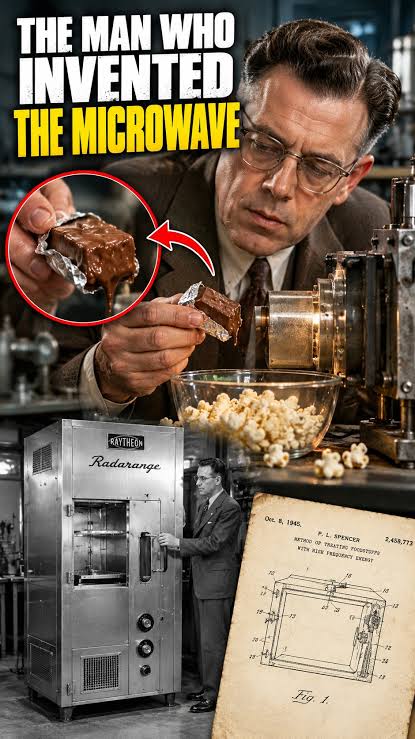
The pivotal moment occurred in 1945. While standing beside an active magnetron in the lab, Spencer noticed something bizarre: the peanut candy bar in his pocket had melted into a sticky mess.
Instead of brushing it off as a strange coincidence, Spencer’s scientific intuition kicked in. He immediately sent a colleague out for a bag of popcorn kernels. Holding them near the magnetron tube, he watched in fascination as the kernels began to pop, scattering across the laboratory floor.
The next morning, eager to test his hypothesis on liquids and proteins, he aimed the tube at an egg. Within seconds, the internal heat caused the egg to expand, tremble, and explode—splattering an unsuspecting colleague who had leaned in for a closer look.
Spencer realized a profound truth: the invisible electromagnetic waves used for radar could penetrate and heat food rapidly from the inside out.
The Behemoth “Radarrange” and the $2 Reward
On October 8, 1945, Raytheon filed the patent for the microwave cooking process. Two years later, in 1947, the company unveiled the world’s first commercial microwave oven: the Radarrange.
Unlike the sleek appliances in modern kitchens, the original Radarrange was an industrial monster:
- Standing nearly 6 feet tall
- Weighing a staggering 750 pounds
- Requiring dedicated water plumbing to keep its internal systems cool
- Carrying a hefty price tag of thousands of dollars—making it accessible only to luxury liners, railway dining cars, and high-end restaurants.
As for Spencer’s financial reward? In keeping with corporate policy at the time, Raytheon gave every employee inventor a standard token payment of $2 for assigning their patent to the company.
A Legacy Beyond Measure
Spencer didn’t harbor bitterness over the nominal payout. He continued doing what he loved, collecting well over 100 patents during his illustrious career and ultimately rising to become Senior Vice President of the very company he joined as a self-taught electrician.
When Percy Spencer passed away in 1970, countertop microwaves were just beginning to find their way into homes. Today, his accidental discovery remains a cornerstone of modern domestic life—proving that monumental innovation often springs from the unlikeliest of places, driven by a curious mind asking a simple question.
Stay tuned to ABT News for more deep dives into the untold stories of technology, innovation, and industry disruptors.


 By