
Across Nigeria and vast swathes of sub-Saharan Africa, a heartbreaking paradox defines the agricultural landscape: fields burst with green abundance, yet millions of tons of crops never make it to a dinner plate! Industry estimates reveal that up to 60 to 70 percent and occasionally over 80 percent in remote farming clusters, of all agricultural produce rots away before it can be consumed or processed.
For a country losing an estimated ₦3.5 trillion to ₦5 trillion annually to post-harvest waste, this is not merely an agricultural hurdle; it is an economic hemorrhage. With inflation squeezing household budgets to the limit, every rotting crate of tomatoes, basket of fruits, or batch of fishes represents money bleeding straight out of some of the continent’s most vulnerable rural households.
The primary culprit? The cold chain gap and a severe lack of dependable rural energy.
With over 85 percent of rural farming communities disconnected from reliable grid electricity, conventional refrigeration or processing has elusively remained an impossible dream.
Now, a quiet revolution is taking root across the continent. Visionary agribusinesses and clean-tech pioneers are proving that the answer isn’t tied to the unstable national grid. It is beaming down directly from the sky.
THE TWO-PRONGED FIX: CHILL IT & DRY IT
Tackling a crisis of this magnitude requires more than a one-size-fits-all approach. Across Nigeria’s agricultural hubs, innovators are deploying two powerful solar-driven interventions to extend the shelf life of perishable goods: Solar Cold Rooms and On-Site Solar Dryers.
1. Chill It: The Power of Decentralized Cold Storage
For fresh fruits, vegetables, and fisheries, temperature control is everything. Without it, produce begins to degrade within hours of harvest.
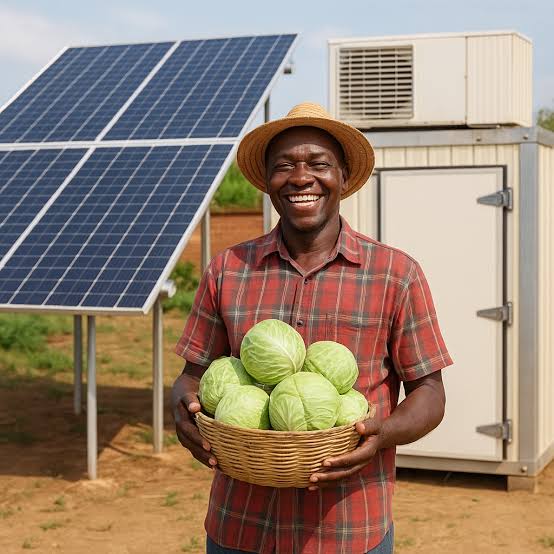
Pioneering enterprises like ColdHubs have changed the game by deploying walk-in, solar-powered cold rooms directly into farm clusters and bustling open-air markets. Operating on a flexible “pay-as-you-store” subscription or per-crate model, these modular 20- to 40-foot containers utilize high-efficiency photovoltaic panels and advanced battery banks to maintain optimal cold temperatures (4–10°C) continuously—even through days of heavy cloud cover.
Similarly, innovators like Ecotutu and Eja Ice are bridging the logistics divide with solar-powered cold rooms and refrigerated transport solutions that protect everything from perishable tomatoes to artisanal fish catches from farm gate to urban market. By scaling these units, cooperatives have successfully watched post-harvest losses plummet from a devastating 50 percent down to under 10 percent.
2. Dry It: Transforming Surplus into Stability
When cold storage isn’t immediately accessible or surplus yields threaten to flood the market, conversion is key. Companies like NaFarm Foods in Kaduna are stepping in with custom-built, solar-powered dehydration systems installed right on farmland.
By converting vulnerable fresh crops, like surplus tomatoes and peppers, into stable, long-lasting flakes, purees, and dried powders, these systems rescue harvests that would otherwise be dumped. It eliminates spoilage while insulating farmers from the frantic, forced-sale price crashes that plague glut seasons.
THE REAL BOTTLENECK: OVERCOMING HUMAN RESISTANCE
While engineering efficient photovoltaic panels, DC compressors, and thermal storage has proven technologically achievable, industry operators agree that the hardware is only half the battle.
The harder part isn’t capturing sunlight; it is building trust.
Generations of smallholder farmers have learned to be deeply risk-averse. Asking a rural farmer who has spent months laboring over a single harvest, to hand over his fragile produce to a new technology or an unfamiliar corporate model requires immense community engagement. Overcoming skepticism, demonstrating transparent value, and aligning pricing models with local cash flows remain the true litmus tests for widespread adoption.
A Brighter Economic Horizon
The economic case for solar-powered preservation is unassailable. When a farmer can store produce safely instead of watching it rot within 48 hours, market timing shifts into their hands. They can negotiate fair prices, guarantee food safety, and protect household incomes.
As Nigeria and neighboring African nations look toward long-term food security, scaling solar-driven cold chains and processing tech is no longer optional. By turning blinding tropical sunlight into an active shield against decay, Africa is finally beginning to secure the fruits of its own labor—one solar-cooled crate at a time.
Donations towards that are also welcome via PayPal using our email: https://www.paypal.com/ncp/payment/EK862PDNRG9CW



 By
By