
By ABT NEWS Desk | www.abtnews.net
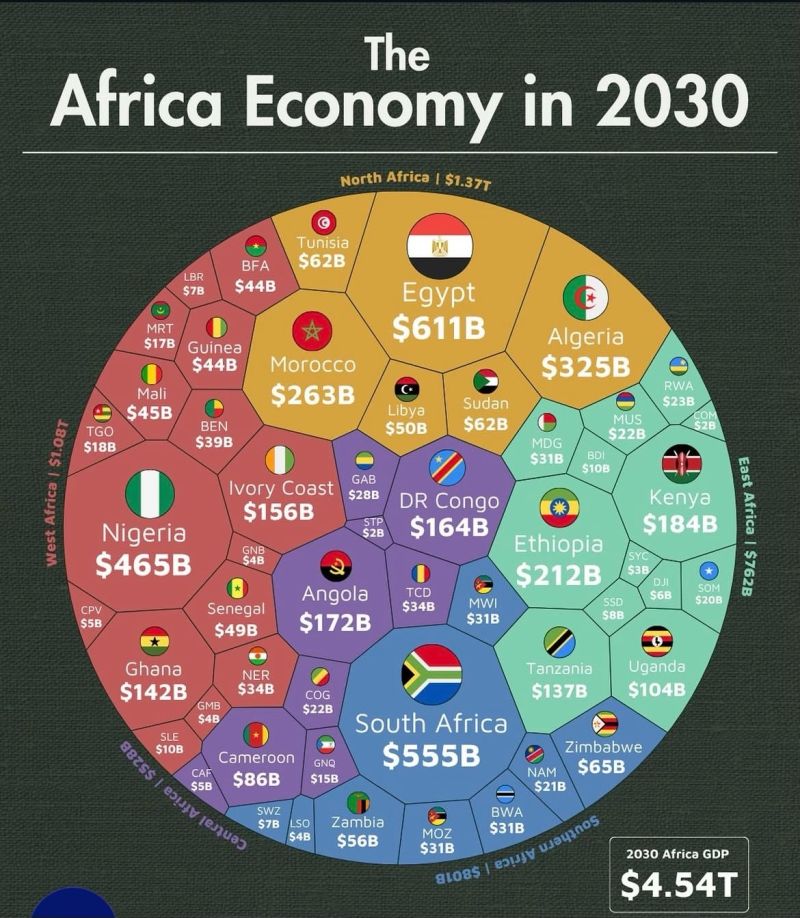
The narrative surrounding Africa’s economic future is undergoing a massive shift. By 2030, the continent’s combined Gross Domestic Product (GDP) is projected to reach a staggering $4.54 trillion. But the true story isn’t just in the headline number—it’s in where this unprecedented growth is coming from.
Driven by rapid urbanization, soaring digital adoption, aggressive infrastructure investments, and a surge in intra-African trade, the economic center of gravity is expanding. Africa’s next decade won’t be dominated by a single economic giant, but rather by a powerful network of interconnected regional hubs.
Here is a closer look at the financial projections shaping the continent’s tomorrow.
The Top 5 Economic Heavyweights
While growth is distributing across the continent, five nations are projected to remain the primary engines of Africa’s financial output by 2030. These major players will account for a substantial share of the continent’s wealth:
- 🇪🇬 Egypt: $611 Billion
- 🇿🇦 South Africa: $555 Billion
- 🇳🇬 Nigeria: $465 Billion
- 🇩🇿 Algeria: $325 Billion
- 🇲🇦 Morocco: $263 Billion
The Rising Stars: Distributed Growth Centers
The most exciting trend in this financial forecast is the rise of diversified growth markets. Economic opportunity is spilling beyond traditional borders, empowering a new wave of formidable economies:
- Ethiopia: $212 Billion
- Kenya: $184 Billion
- Angola: $172 Billion
- DR Congo: $164 Billion
- Côte d’Ivoire: $156 Billion
- Tanzania: $137 Billion
These emerging centers prove that investor attention can no longer be limited to just two or three countries. The playing field is widening, offering lucrative opportunities across various sectors and consumer segments.
The Regional Power Breakdown
When zoomed out, the regional distribution reveals a continent moving forward on multiple fronts. Here is how Africa’s major regions stack up in the $4.54 trillion projection:
- North Africa: $1.37 Trillion
- West Africa: $1.08 Trillion
- Southern Africa: $801 Billion
- East Africa: $762 Billion
- Central Africa: $528 Billion
The Bigger Picture for Investors and Businesses
For global businesses, policymakers, and investors, the key question is no longer how large the African economy will become, but rather who will capture that growth.
Which cities will become the next fintech capitals? Which consumer segments will drive digital retail? Which infrastructure projects will connect these multi-billion-dollar markets?
The Africa of 2030 will be defined by its interconnectivity. It is an emerging market that is more regional, increasingly digital, and ripe with opportunities for those who look beyond the surface.
Stay tuned to ABT NEWS for more exclusive insights and breaking coverage on global economic trends.

ABT NEWS Platform is absolutely free for all to enjoy. However please support us by grabbing a copy of the above eBook. A portion of the sales goes towards supporting girls to acquire AI skills. Donations towards that are also possible via PayPal using our email: info@abtnews.net


 By
By