
In 1962, NASA had a room-sized IBM 7090 computer calculating the complex orbital trajectories required to put a human into space. But the technology was new, and nobody—especially the astronauts whose lives depended on it—fully trusted the electronic machines.
Before astronaut John Glenn would step into the Friendship 7 capsule to become the first American to orbit Earth, his instructions to the engineers were blunt: “Get the girl to check the numbers”.
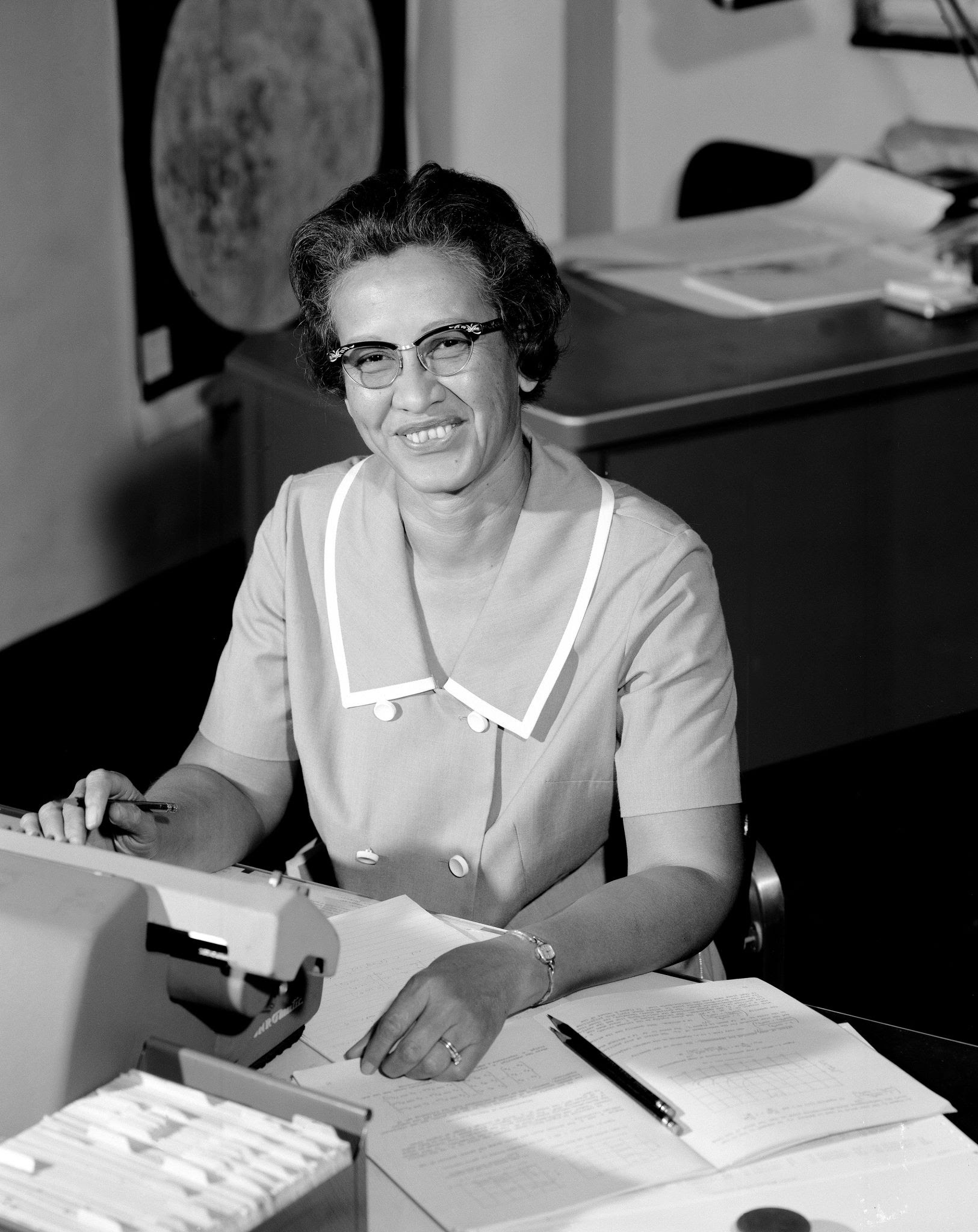
That “girl” was Katherine Johnson, a brilliant 44-year-old mathematician. Glenn insisted that she run the exact same equations through her desktop mechanical calculating machine by hand.
“If she says they’re good,” Glenn declared, “then I’m ready to go”.
She ran the numbers. He flew.
What makes Johnson’s story profoundly inspiring isn’t just her staggering intellect, but the barriers she had to break to use it. Working in the Jim Crow-era South at NASA’s Langley Research Center, Johnson was forced to use segregated bathrooms and eat at segregated tables. Despite her degrees and undeniable genius, the agency didn’t even give her the title of “mathematician” or “engineer.” Instead, she and her Black female colleagues were housed in a segregated building and classified simply as “Computers”.
Despite the daily indignities of systemic racism, Johnson’s trajectory work shaped the Golden Age of Space Exploration.
A Legacy Written in the Stars
1961 First American in Space
Johnson analyzed the flight trajectory for Alan Shepard’s Freedom 7 mission, ensuring the first U.S. human spaceflight was a success.
1962 First American in Orbit
She calculated and verified the orbital equations for John Glenn’s historic flight, securing America’s footing in the Space Race.
1969 The Moon Landing
Her flawless trajectory calculations for Apollo 11 carried the first humans safely to the lunar surface and back home again.
1970 A Safe Return
When an explosion crippled Apollo 13, Johnson’s previous work on backup parameters and navigation charts was critical in helping the crew adjust their course and return safely to Earth.
Katherine Johnson passed away in 2020 at the remarkable age of 101. Years before her passing, President Barack Obama presented her with the Presidential Medal of Freedom, the nation’s highest civilian honor, cementing her rightful place in American history.
She was a woman who saw no limits in the sky or in society. In a world rushing toward automation, her story is a powerful reminder of the indispensable value of human brilliance.
When the stakes were highest, and the lives of American heroes hung in the balance, a pencil beat the processor.


 By
By