
By ABT News Desk
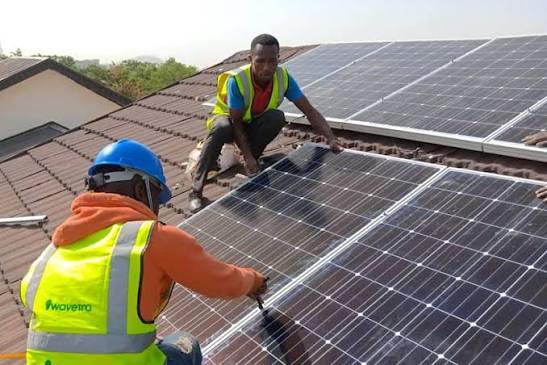
Solar power has quietly become Nigeria’s default fix for an electricity crisis that leaves roughly 87 million people in the dark. Across the nation, homes and small businesses neglected by the struggling national grid and expensive diesel generators have looked to the sky, installing rooftop panels at a record pace.
Yet, there is a glaring problem hanging over this solar revolution: almost none of the hardware is made in Nigeria.
David Terungwa, head of the Global Initiative for Food Security and Environmental Protection, put it bluntly at a recent Lagos industry gathering. He described the current sector as an “all-comers’ affair”—largely unregulated and dangerously dependent on foreign supply chains.
This raises a vital, overarching question for the nation’s future: What will it actually take for Nigeria to form a cardinal, actionable policy on hybrid energy sources that not only includes solar, but builds a clean-energy economy from the ground up?
Based on exclusive industry insights, the roadmap requires navigating three major hurdles: manufacturing ambition, investment realignment, and activating dormant laws.
1. The Manufacturing Leap: Subsidies Over Bans
The Tinubu administration’s vision is ambitious. According to Olamide Fagbuji, the president’s senior special assistant on climate technology, Nigeria must stop being a mere customer and become a manufacturer. Pointing to China, India, and Vietnam as blueprints, Fagbuji argues for a deliberate industrial policy that transforms Nigeria into a producer and exporter of renewable equipment.
However, how we get there is a matter of fierce debate. Nigeria has historically relied on import bans to force local industries into existence. Some in the solar sector are lobbying for this exact treatment.
Terungwa warns this would be a catastrophic misstep. Cutting off imports before domestic factories can meet demand won’t create local manufacturing—it will just leave more people without power. The required policy shift must lean on the carrot, not the stick: offering subsidies and incentives for local assembly, providing cheaper financing for clean-energy systems, and exercising patience.
There are early signs of hope, such as new lithium battery plants in Zamfara and Nasarawa states, and initial groundwork by the National Agency for Science and Engineering Infrastructure for domestic panel production.
2. Following the Money: Breaking the Oil Monopoly
To build a cardinal hybrid energy policy, Nigeria must completely overhaul where its energy capital flows.
Daniel Awolaja, co-founder of the Africa Energy Tracker, recently revealed a staggering statistic: over the past decade, Nigeria attracted close to $100 billion in disclosed energy investment across 422 projects. Yet, an overwhelming 92% of that capital was swallowed by oil and gas. Renewables, grid infrastructure, and storage were left to fight over the scraps.
Furthermore, while Nigeria boasts roughly 14 gigawatts of installed generation capacity (adding a massive 3 gigawatts in 2025 alone), only about 5 gigawatts actually make it to the grid due to severely underfunded transmission and distribution networks. A true hybrid energy policy must mandate infrastructural investment to ensure power generated actually reaches homes.
3. The Policy Paradox: Waking the Sleeping Giant
Ironically, Nigeria doesn’t necessarily need new frameworks; it needs to use the ones it already has.
Nigeria’s mini-grid rules and duty exemptions on imported solar gear date back to 2015. They were so progressive that when a Nigerian energy expert traveled to Brazil to study their mini-grid regulations, Brazilian officials pointed out that Nigeria’s own framework was vastly superior. Yet, it has sat largely dormant at home.
The breakthrough may be the Electricity Act of 2023, which decentralizes power, allowing states to run their own electricity markets. This legislative shift has already unlocked over $1.3 billion in commitments for distributed renewable energy. A cardinal hybrid policy must build on this decentralization, empowering states to tailor energy mixes to their local resources.
4. Beyond Solar: Tapping the Full Hybrid Spectrum
Finally, a robust cardinal policy cannot rely on solar alone. To create a resilient grid, Nigeria must integrate its vastly untapped natural resources to fill the gaps when the sun isn’t shining:
- Waste-to-Energy: Nigeria produces roughly 32 million tonnes of solid waste annually. Utilizing incineration, gasification, and anaerobic digestion could power cities and clean up streets in Lagos, Abuja, and Port Harcourt.
- Small Hydropower: While massive dams like Kainji anchor current output, decentralized “small hydro” can easily electrify rural communities and support irrigation without the massive infrastructure costs of mega-dams.
- Wind: The northern and coastal belts possess commercially viable wind resources. Paired with solar in hybrid mini-grids, wind could provide baseline power during the night.
- Biomass & Biogas: With an estimated ₦3.5 trillion lost annually to post-harvest waste (rice husks, cassava peels), converting agricultural refuse into power offers both a climate solution and a secondary income stream for local farmers.
- Geothermal: Barely explored, yet hot springs in Nasarawa, Plateau, Benue, and Taraba states hold the key to a clean energy source that operates 24/7, completely independent of the weather.
The Bottom Line
For Nigeria to establish a definitive, cardinal policy on hybrid clean energy, the government must view renewables not as a charity case, but as a core business proposition—a shift pioneered by impact investors like All On.
It will take a synchronized effort: activating the brilliant but dormant policies already on the books, aggressively redirecting investment away from fossil fuels toward grid infrastructure, incentivizing local manufacturing without triggering power shortages, and diversifying beyond solar into a true multi-source hybrid grid. Only then will Nigeria stop buying the future, and start building it.
GLOBAL TECH WATCH: While Nigeria tackles its grid, the global AI boom faces its own power crisis. This week, Schneider Electric and AMD released a blueprint to deploy AI data centers faster, combating the massive energy draw of modern computing. Their new reference design supports clusters up to 10.4 megawatts, using hybrid air-liquid systems to strip out 84% of the heat generated by hardware—a stark reminder that as technology advances, innovative power management must follow.


 By
By