

Byline: ABT NEWS Desk
It’s been 17 years since Jamaican sprinting legend Usain Bolt cemented his legacy by running the 100-meter dash in a blistering 9.58 seconds. For nearly two decades, no human could touch it. But this weekend in Beijing, that record finally fell—not to flesh and bone, but to titanium and artificial intelligence.
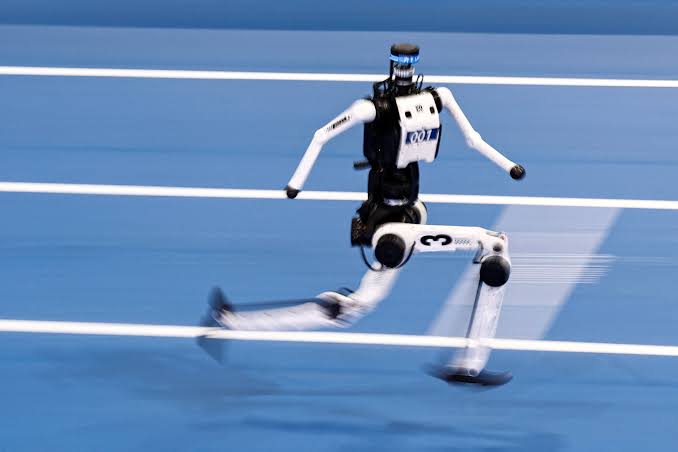
At the 2nd World Humanoid Robot Games, held at Beijing’s National Speed Skating Oval (the “Ice Ribbon”), two humanoid machines officially surpassed the historic human mark.
In a breathtaking preliminary heat, a robot named Tiangong Ultra—developed by the Beijing Humanoid Robot Innovation Center—stormed across the finish line with a time of just 9.39 seconds. Trailing closely behind was Lightning, a robot built by Chinese smartphone manufacturer Honor, which clocked in at 9.47 seconds.
Lightning had already raised eyebrows in pre-race testing by logging an astonishing 9.32 seconds, hitting a top speed of 14.5 meters per second.
A Not-So-Graceful Finish
While the speed of these machines is undeniably spectacular, their stopping mechanics still need some serious work. Running faster than Usain Bolt proved to be the easy part; pulling the brakes was a different story.
After crossing the finish line, both robots slammed violently into thick protective cushions designed to halt their momentum. Footage from the event showed Tiangong Ultra stumbling chaotically toward the sidelines, forcing spectators to scramble out of the way. Lightning collapsed entirely upon impact and had to be awkwardly carried off the track on a stretcher.
An Industry in Hyperdrive
The leaps in speed highlight the blistering pace of China’s robotics industry. At the inaugural games just last year, Tiangong Ultra won the 100-meter dash in 21.50 seconds. Trimming more than 12 seconds off that time in a single year demonstrates a massive leap in actuator technology and AI-driven balance control.
This year’s “Olympics-like” event has expanded massively, drawing 2,056 robots from 666 teams across 16 countries. The 100-meter dash wasn’t the only human record to fall, either. Another robot at the event shattered the standing high jump record, clearing 2.88 meters to beat Cuban athlete Javier Sotomayor’s 1993 human world record of 2.45 meters.
While the spectacle of humanoid robots breaking athletic world records is thrilling, the ultimate goal for policymakers and tech giants isn’t Olympic gold. These demonstrations are high-profile stress tests for machines that companies hope will soon be deployed across manufacturing, logistics, and consumer homes globally.
For now, humanity can rest easy knowing that while robots might outrun us, we still know how to cross a finish line without needing a stretcher.



 By
By