
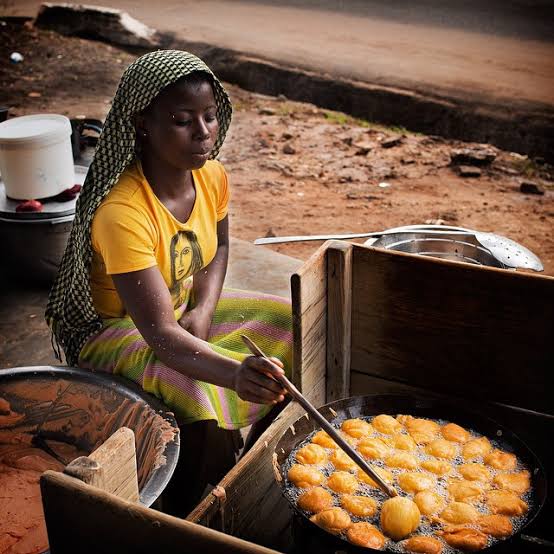
In what is rapidly being dubbed Aso Rock’s “Marie Antoinette moment,” Nigeria’s First Lady, Senator Oluremi Tinubu, has inadvertently ignited a massive digital firestorm. Her recent proposition for struggling Nigerians to escape the crushing grip of poverty? Start selling akara (fried bean cakes), roasted corn, and kuli-kuli
Speaking to State House Correspondents after the Renewed Hope Initiative’s second-quarter meeting with wives of state governors in Abuja, the First Lady highlighted the cash grants her office has disbursed to vulnerable citizens.
“We’re trying to give hope, and to start akara business doesn’t take a lot of money. To start roasting corn, or somebody even said kuli kuli doesn’t take much,” she declared, adding, “We didn’t give them a loan; we gave it to them as a grant.”
While her remarks were ostensibly framed around grass-roots economic empowerment, supplementing the billions donated by her initiative for tuberculosis, breast cancer, and malnutrition, the optics landed terribly against the backdrop of the intense acute hardship Nigerians currently face.
The Shenanigans: A Digital Uproar
The online reaction was as swift as it was brutal, exposing a widening chasm between the political elite and the agonizing daily reality of ordinary citizens.
Across social media, the backlash was visceral. Critics tore into the administration, pointing out the glaring irony of pushing citizens toward petty survival trades while the political class maintains its luxury. One vocal user on X, @ADCVanguard_, captured the prevailing mood, stating the video showed “exactly how disconnected Nigeria’s ruling class has become from the reality of ordinary citizens.”
The debate quickly morphed into a national referendum on the administration’s economic policies. Another commentator, @TossynBankz_, offered a nuanced take that resonated widely: “Nobody is mocking akara, roasted corn, or kuli-kuli. Those are honest businesses. The problem is that Nigerians are asking for a better economy, more jobs, and lower prices.”
Not everyone was throwing stones. A vocal minority rushed to the First Lady’s defense, arguing for the inherent dignity of labor. Supporters pointed out that the street food trade has historically funded university educations and built homes. Yet, in today’s severe macroeconomic climate, that defense feels like nostalgia for a bygone era.
ABT News Critique: The Agricultural and Economic Disconnect
To truly appraise the First Lady’s statement requires looking past the political noise and examining the raw economic data and the realities of the African agricultural value chain.
The assertion that starting an akara or roasted corn business “doesn’t take a lot of money” fundamentally ignores the current hyper-inflationary environment gripping Nigeria’s food systems. According to the latest National Bureau of Statistics (NBS) data for May 2026, headline inflation sits at 15.93%, with food inflation remaining elevated at 16.96%.
More critically, the core inputs for these “cheap” businesses—maize, beans, and groundnuts—are currently victims of a severely fractured agricultural supply chain. Deepening insecurity in farming regions, coupled with skyrocketing transportation logistics and fertilizer costs, has driven the wholesale prices of these raw commodities to unprecedented highs.
When a single bag of beans or a sack of maize consumes a staggering percentage of a family’s monthly income, suggesting that petty trading is a viable ladder out of poverty is economically flawed. Furthermore, frying akara requires cooking oil and fuel (firewood or gas)—both of which have seen massive price shocks following the removal of fuel subsidies.
From a structural standpoint, wealth creation and true poverty eradication do not come from subsidizing the micro-informal sector with one-off grants. With the World Bank projecting that a staggering 83% of Nigerians will live below the poverty line by 2027, escaping this demographic trap requires something much larger. It demands robust industrialization, heavy investment in the agro-allied processing value chain (scaling from roadside roasted corn to commercial maize processing, and utilizing by-products for poultry and piggery feed production), and the creation of legal and regulatory frameworks that attract serious foreign direct investment.
The Bottom Line
Senator Tinubu’s Renewed Hope Initiative undeniably provides critical lifelines in healthcare and social welfare. However, the overarching economic messaging must evolve. Nigerians are not asking for the seed capital to fry bean cakes in a failing economy; they are demanding a reformed, secure macroeconomic environment where businesses of all sizes can thrive without being suffocated by systemic infrastructural deficits.
Until the underlying structural defects of the economy are addressed, telling the masses to sell akara will continue to sound tragically close to “let them eat cake.” And the French Revolution readily comes to mind!
It pays to advertise your business, products and services on ABT NEWS www.abtnews.net. Please send your enquiries to advertise@abtnews.net or +447918790290


 By
By