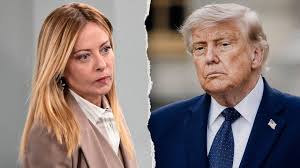

ROME/WASHINGTON — A deepening diplomatic crisis has erupted between Washington and Rome, as Italian Prime Minister Giorgia Meloni issued a stinging public rebuttal to U.S. President Donald Trump, categorically denying claims that she “begged” him for a photograph during last week’s Group of Seven (G7) summit in Evian-les-Bains, France.
The explosive exchange, which has sent shockwaves through European political circles, threatens to dismantle what was once considered one of the strongest ideological alliances of the Trump presidency.
The Spark: A Transatlantic War of Words
The controversy began following a phone interview Trump gave to the Italian broadcaster La7. In an unexpected deviation from the diplomatic protocol typically reserved for G7 partners, the U.S. President claimed that Meloni had repeatedly asked for a photo with him, asserting that he only agreed to the request because he “felt sorry for her.”
Trump further leveraged his platform on Truth Social to escalate the rhetoric, alleging that Meloni is “doing poorly in Italy” and suggesting her standing is faltering—a charge he linked to her refusal to align with U.S. strategic demands.
Meloni’s Sharp Retort
In a decisive video response, the Italian Prime Minister did not mince words. Clearly agitated by what she described as a personal and national affront, Meloni declared the President’s statements “completely fabricated.”
“I don’t know why the president of the United States behaves this way toward his own allies,” Meloni stated. “But there’s one thing he must remember: Italy and I do not beg.”
The response has triggered a wave of solidarity across Italy’s political spectrum, with officials rallying to defend the Prime Minister’s dignity. The backlash was immediate and material: Italian Foreign Minister Antonio Tajani canceled a high-stakes trip to Miami, where he had been scheduled to meet with U.S. Secretary of State Marco Rubio, signaling a significant cooling of bilateral ties.
What Is Really at Stake?
While the public focus remains on the “photo-op” row, analysts warn that the spat is merely a symptom of a much deeper strategic schism. The primary source of the tension appears to be Italy’s refusal to permit the United States to utilize Sicilian airbases for military operations in the ongoing war in Iran.
Trump’s frustration, according to observers, stems from what he views as a lack of loyalty from a long-time partner. Conversely, Meloni is fighting to maintain Italian sovereignty and, simultaneously, her reputation as a pivotal “bridge” between Washington and a skeptical European Union.
The Implication for US-Italy Relations
For years, Meloni had been viewed as a standard-bearer for the Trump-aligned right in Europe. The two leaders had enjoyed a cordial—at times “fantastic,” in Trump’s own words—relationship, solidified by Meloni’s high-profile visit to Mar-a-Lago before the 2025 inauguration.
That image of a “solid, privileged” alliance now appears to be in ruins. The incident raises urgent questions about the future of transatlantic cooperation. If the U.S. administration continues to isolate or attack key European allies over strategic disagreements, experts suggest the unity of the West could face its most significant test yet.
As Rome and Washington stare each other down, the international community is left to wonder: Is this a temporary outburst, or the beginning of a profound realignment of the transatlantic order?
Stay tuned to ABT NEWS for live updates as this developing story continues to unfold. Please send all your advertising enquiries to advertise@abtnews.net or +447918790290

 By
By