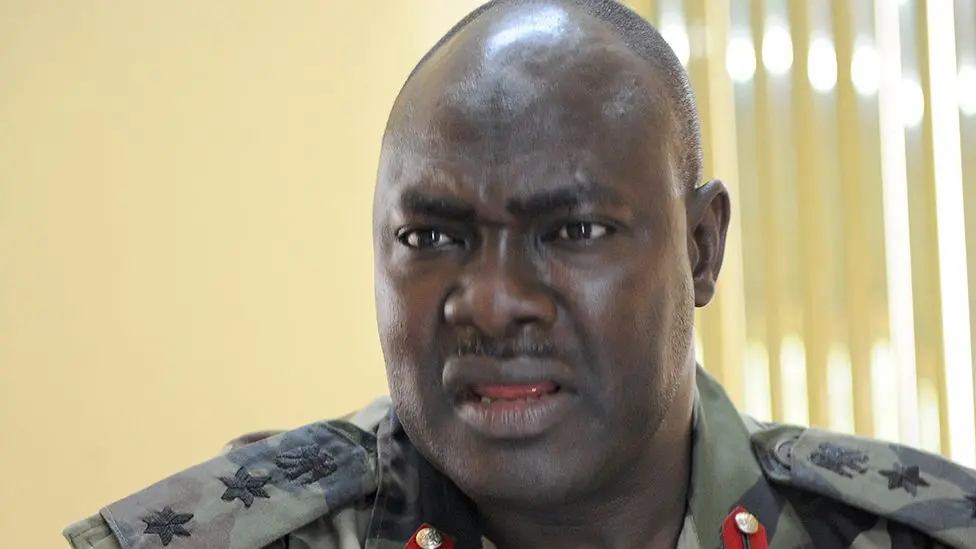

The unthinkable has happened, and it has shattered whatever lingering illusion of security Nigerians had left. Major General Rabe Abubakar (Rtd.)—a two-star general, a man who dedicated his life to defending the territorial integrity of Nigeria, and the former Director of Defence Information—has died in the unforgiving grip of kidnappers in Katsina State.
Kidnapped on May 30 while simply traveling to a wedding with his wife, the General was paraded in a humiliating hostage video, visibly frail and nursing a leg injury, begging for the government’s intervention. Almost two weeks later, the Katsina State Government confirmed the grim reality: the General is dead, reportedly succumbing to complications from diabetes and hypertension while abandoned in a militant camp. His wife’s fate remains terrifyingly unknown.
This tragedy forces every Nigerian to confront a chilling, unavoidable question: If the Nigerian state cannot protect a decorated Major General, what is the fate of the common man on the street?
The Complete Collapse of the Safety Net
General Abubakar was not a faceless citizen. Between 2015 and 2017, he was the literal voice of the Nigerian military, communicating counter-insurgency triumphs to the world. Yet, when he was snatched on the Marabar Musawa-Kafinsoli road, the immense weight of the Nigerian Armed Forces could not extract him in time.
If a man of his stature and connections can be ambushed in broad daylight, dragged into the forest, and left to die while security agencies scramble, the ordinary Nigerian—the farmer in Sokoto, the trader in Zamfara, the student in Kaduna—is entirely defenseless.
The everyday citizen does not have military rescue operations deployed for them. They do not have government spokespersons drafting press releases about their disappearances. When the common man is taken, their families are left to sell their homes, empty their life savings, and beg on social media to pay exorbitant ransoms to ruthless warlords. The General’s death is a damning indictment of a system that has allowed non-state actors to become the ultimate authorities of life and death.
Why the Unending Kidnapping Spree?
How did a nation with one of the largest standing armies in Africa become a playground for kidnappers? The answer lies in a toxic cocktail of impunity, economics, and ungoverned spaces:
- The Commercialization of Terror: Kidnapping in the North-West is no longer just an ideological insurgency; it is a booming, multi-billion-naira dark economy. “Bandits” have realized that human beings are the most lucrative cash crops.
- Ungoverned Spaces: Vast expanses of forests spanning Katsina, Zamfara, Kaduna, and Niger states have been entirely ceded to criminal gangs. These forests serve as fortresses where outlaws operate with zero state presence.
- Consequences are Rare: The risks for the kidnappers are abysmally low compared to the financial rewards. Until the state can prove that kidnapping guarantees swift, absolute destruction for the perpetrators, the spree will only scale up.
What is the Government Actually Doing?
In the wake of the General’s death, the rhetoric from the authorities has been agonizingly predictable. The Katsina State Government called it a “dark moment.” The military promised that “operations have been further intensified to bring perpetrators to justice.”
But Nigerians are exhausted by the endless loop of “condemned in the strongest terms” and “we will leave no stone unturned.” While it is true that the military is actively conducting airstrikes—such as the bombardment of an alleged militant camp in Sokoto late last year—and ground troops are stretched thin across multiple theaters of conflict, the approach remains largely reactive.
What the government is currently doing is fighting a symptom rather than the disease. To stop the incessant kidnapping plaguing Nigeria, the government must move beyond issuing condolences for high-profile casualties. It requires cutting off the financial networks funding these terrorists, holding local security heads accountable for breaches in their jurisdictions, and permanently occupying the forest fortresses these criminals call home.
Major General Rabe Abubakar dedicated his life to the Nigerian flag, only to have his life extinguished in the shadows of a bandit camp. If his tragic death does not force a radical, ruthless change in Nigeria’s security architecture, then we must brace ourselves for a reality where the street belongs to the gunmen, and every citizen is just waiting for their turn.
It pays to advertise your business and services on ABT NEWS www.abtnews.net. Please send all enquiries to advertise@abtnews.net or +447918790290


 By
By