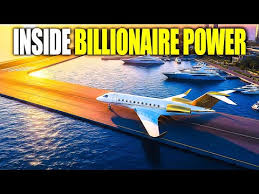

“If poor people knew how rich rich people are, there would be riots in the streets.”
When comedian Chris Rock dropped this provocative bombshell, he wasn’t just working the crowd—he was pulling back the curtain on a parallel universe. He pointed out that the average person would be stunned just by the free food and massages in a first-class airline lounge. But a decade later, the reality of billionaire excess has evolved far beyond VIP lounges. Today, it is about a profound, systemic concentration of capital that defines modern society.
The Staggering Reality of 2026
The global wealth gap isn’t just widening; it has completely shattered historical precedents. We are no longer looking at a simple divide between the “haves” and “have-nots,” but rather a chasm between the ultra-wealthy and everyone else.
Recent 2026 data reveals the astonishing scale of this divide:
- A Historic Peak: Global billionaire wealth jumped by over 16% in a single year, reaching a record $18.3 trillion.
- The 0.001%: Fewer than 60,000 individuals worldwide now control three times as much wealth as the entire bottom half of humanity.
- The Bottom Half: While the top 10% of the world’s population hoards 75% of all global wealth, the bottom 50% scrapes by on a mere 2%.
- The Power of Growth: The collective wealth gained by billionaires in just twelve months—roughly $2.5 trillion—is enough to eradicate global extreme poverty 26 times over.
In the UK alone, the richest 56 individuals now hold more combined wealth than 27 million everyday citizens. It is a tale of two economies existing on the exact same planet, where the compounding interest of the elite wildly outpaces the physical labor of the working class.
The Hidden Luxury
What Rock observed so sharply is that true wealth is largely invisible to the public eye. The working class measures success by income—a better salary, a nicer car, a larger mortgage. The ultra-wealthy measure success by asset accumulation, equity, and leverage.
Their reality is completely insulated from the frictions of daily life. It is an ecosystem of family offices, generational trusts, private equity networks, and political influence that the average worker cannot even conceptualize. As Oxfam recently noted, billionaires are now estimated to be 4,000 times more likely to hold political office than ordinary citizens, allowing them to shape the very economic rules that govern the middle class.
From Outrage to Opportunity: The Mindset Shift
This powerful commentary shouldn’t just spark outrage; it should serve as a wake-up call for personal finance. Recognizing the stark realities of the global economy is the first step toward financial independence.
For the ambitious, these statistics highlight exactly why relying solely on a paycheck is a losing battle against inflation and economic disparity. To thrive in today’s landscape, you have to adopt the strategies that the wealthy use to compound their fortunes:
- Acquire Assets, Not Liabilities: The 1% build wealth through ownership—equities, real estate, and digital assets—not by trading their time for an hourly wage.
- Harness Compound Interest: Wealth disparity grows because passive accumulation mathematically outpaces salaried earnings over time. Starting early and investing consistently is the only way to catch the wave.
- Invest in High-Level Financial Literacy: Understanding tax codes, market trends, and investment vehicles is what separates the middle class from the financially free.
The gap between the ultra-rich and everyday society may be vast, but the tools to build personal prosperity have never been more accessible. By understanding the true mechanics behind Chris Rock’s bold statement, readers can stop playing a game rigged for consumers and start architecting their own pathways to generational abundance.

 By
By