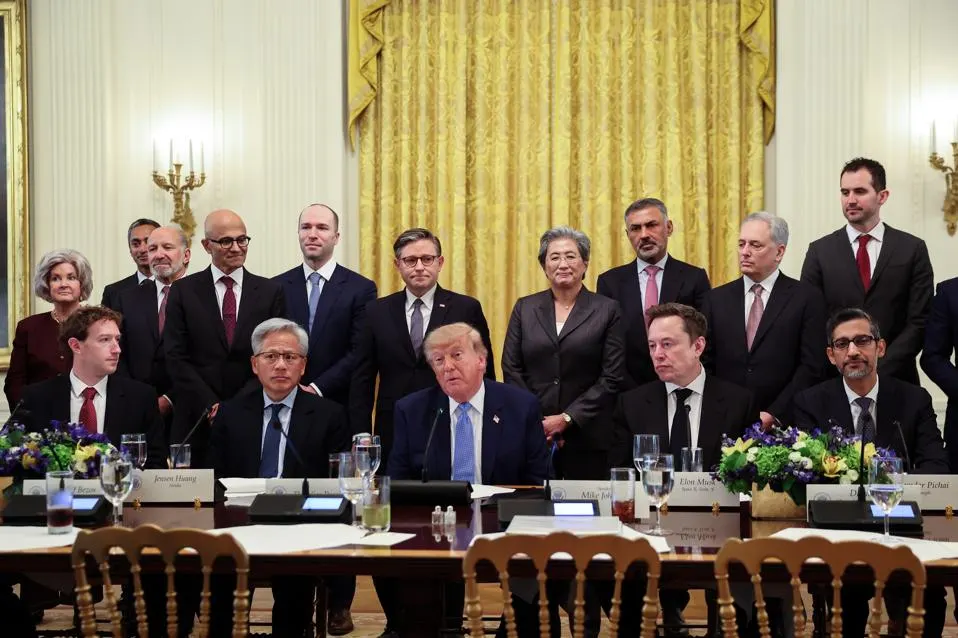

WASHINGTON — In a historic high-stakes gathering at the White House, President Donald Trump hosted the top executives of the world’s leading technology and artificial intelligence firms to address the future of AI governance. Rather than imposing federal regulatory licenses or mandatory government oversight, President Trump unveiled a voluntary self-regulation framework, declaring that tech leaders have agreed to a “constitution” to police themselves.
The announcement has ignited an intense global debate: Can artificial intelligence—and the mega-corporations building it—truly self-regulate, or is self-policing a dangerous illusion?
Inside the White House “Super Intelligence” Summit
The closed-door White House meeting brought together an unprecedented gathering of Silicon Valley titans, including:
- Elon Musk (xAI / Tesla)
- Mark Zuckerberg (Meta)
- Sundar Pichai (Google / Alphabet)
- Jensen Huang (Nvidia)
- Dario Amodei (Anthropic)
- Greg Brockman (OpenAI)
- Jeff Bezos (Amazon)
- Alex Karp (Palantir)
Following the session, President Trump announced the “White House Accord on Super Intelligence” (or SI Accord). Trump praised the agreement as “morally binding” and claimed it would provide a “form of protection through self-policing by AI companies.”
In tandem with the accord, Trump issued an Executive Order directing executive departments to adopt the term “Super Intelligence” (SI) in place of “Artificial Intelligence,” arguing that the older terminology made the technology “sound fake.”
The 4-Tier Self-Policing Framework
The White House Accord establishes four layers of voluntary internal safeguards designed to ensure frontier models are deployed safely:
- Internal Technical Controls: Mandatory internal stress-testing and safety monitoring teams inside each developer firm.
- Third-Party Audits: Periodic evaluations conducted by independent third-party evaluators to stress-test systems.
- Board Oversight Committees: Direct reporting lines from external auditors to independent board committees, bypassing executive leadership to preserve internal accountability.
- Public & Customer Assurance: Commitments to publish safety reviews and maintain public transparency standards.
The Big Debate: Self-Regulation vs. Statutory Guardrails
The Trump administration’s stance shifts American policy sharply toward free-market innovation and national competitiveness, explicitly rejecting mandatory federal licensing or pre-clearance rules that could slow down US development relative to global rivals like China.
The Argument FOR AI Self-Regulation
- Speed & Agility: Traditional legislative processes move at a snail’s pace compared to the exponential speed of frontier model development.
- Technical Complexity: Tech developers understand the inner mechanics and risks of neural networks better than state regulators.
- Global Competitiveness: Heavy-handed regulation risks choking domestic innovation and surrendering technological leadership.
The Argument AGAINST Self-Regulation
- Conflict of Interest: Profit incentives directly counter the economic cost of delaying or scrapping powerful, high-risk models.
- Lack of Legal Teeth: Voluntary accords carry no statutory penalties, fines, or legal enforcement mechanisms if a company fails compliance.
- “Defining Safety”: Critics argue voluntary pacts allow corporations to define their own safety benchmarks without public democratic oversight.
“I’m trying to self-regulate myself, I have all these addictions… I’m not God.”
— Alex Karp, CEO of Palantir, speaking to reporters following the White House luncheon.
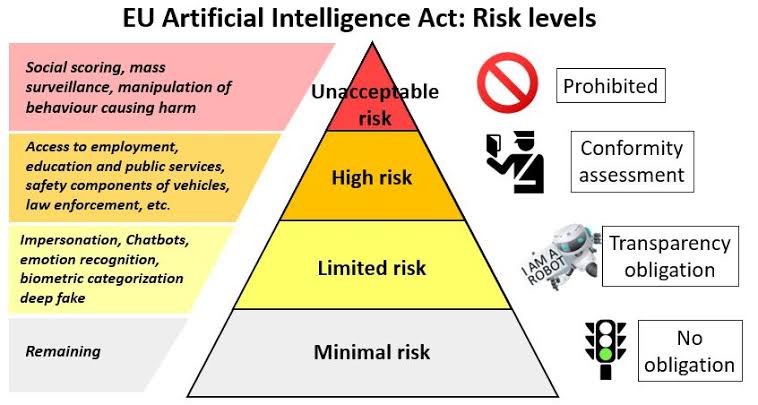
Legal and AI governance experts have expressed sharp skepticism. Professor Kimberlee Weatherall noted that voluntary accords risk becoming a “distraction” that allows tech companies to write their own rules while avoiding enforceable accountability. Meanwhile, foreign jurisdictions—such as the European Union—continue enforcing binding, risk-based statutory requirements with heavy financial penalties for non-compliance.
What Comes Next for ABT NEWS Readers?
As AI models approach human-level reasoning across domain tasks, the question of who holds the reins—governments or the corporations building the software—will shape economics, national security, and civil liberties for decades to come.
Stay tuned to ABT NEWS (www.atnews.net) for continuous live updates, expert analysis, and exclusive breakdowns of this unfolding global policy transformation.
ABT NEWS Platform is absolutely free for all to enjoy. However please support us by grabbing a copy of our eBook below. A portion of the sales goes towards supporting girls to acquire AI skills. Donations towards that are also possible via PayPal using our email: info@abtnews.net

 By
By